Doobie
Multi-head tape echo, spring and plate
Dub is not really about the delay. It is about what happens to the repeats on the way round: the filter sweeps, the tape wearing out, the phaser and the reverb caught inside the loop. Doobie is built around the loop, not around the delay line.
- Type
- Tape delay and reverb
- Formats
- VST3 · AU · CLAP · Standalone
- Systems
- macOS · Windows · Linux
- Version
- v0.25.0 · 2026-07-04
- Licence
- GPL-3.0
Measured figures
- 4 heads
- Playing off one tape loop, each with its own level, pan, time and ±200 ms nudge.
- 16 s
- Of tape buffer, so four bars at a slow tempo still fits with room to spare.
- 9 reverbs
- Spring, plate, hall, shimmer, series, parallel, convolution and an eighties gate.
- 48 IRs
- Bundled real spaces, from York Minster to a nuclear reactor hall.
- ±24 st
- Range of the pitch shifter on the repeats, playable from a keyboard.
- 138
- Factory presets, every convolution one checked by the build to load its space.
Four heads, one tape
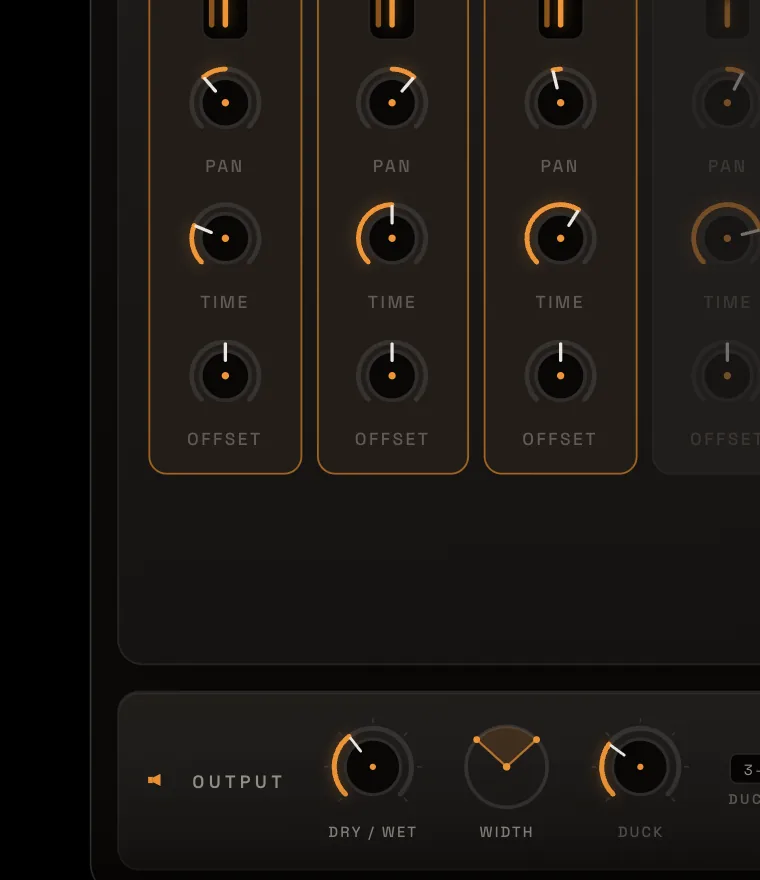
The tape is a single loop, and four playback heads sit along it. Each has its own level, its own pan, its own time, and a nudge of up to two hundred milliseconds either side for the kind of micro-timing that opens a stereo image without touching a width control.
In sync each head snaps to a musical division, so the taps land on the grid; free-running they sit at any continuous fraction of the repeat. A four-pad matrix switches heads in and out while it plays, and switching is silent. Heads ramp instead of cutting, so you can rearrange the rhythm live without a click.
Times run from twenty milliseconds to eight seconds free, or from a sixty-fourth up to four bars locked to the host, dotted and triplet included. The buffer goes out to sixteen seconds, so a slow ambient drone fits with room to spare. Change the division while it is running and the pitch glides like a capstan spinning up, because that is what a capstan does.
Five ways for a repeat to decay
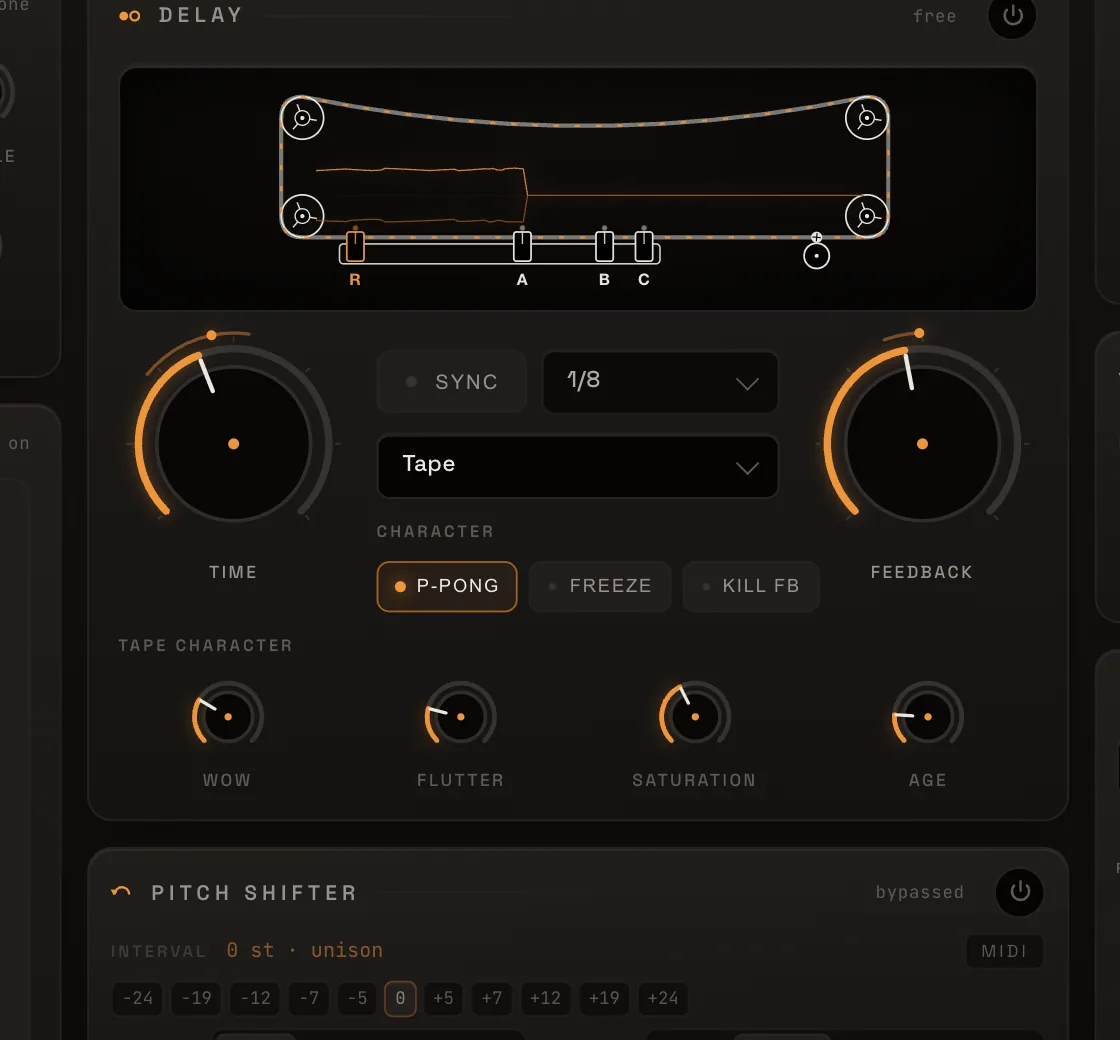
Digital keeps the repeat clean. Tape adds wow, flutter and saturation. BBD is the dark, narrowing bucket-brigade sound, losing top end every time round. Diffuse smears the repeats into a wash instead of a rhythm. And Pitch moves every repeat by an interval you choose.
Over the top of all of that sits AGE, which wears the tape down: hiss, slow level dropouts, progressive high-frequency loss and extra transport instability, compounding a little more on every pass. Turn it up and the twelfth repeat is a different creature from the first.
A pitch shifter you can play
The Pitch character is not a fixed octave trick. The interval is a chip row running from twenty-four semitones down to twenty-four semitones up, so the repeats can climb into shimmer, fall into a sub-octave drone, or move by a fifth and turn a single note into a chord that builds itself as it decays.
It has its own on-off switch, separate from the character selector. That sounds like a small thing and it is the control I use most: it lets you A and B the shifter against itself without changing the delay character underneath, so you can hear exactly what the interval is doing and not what switching modes is doing.
Both the pitch shifter and the shimmer reverb can be driven from a keyboard. Turn on note mode and C3 is unison, C4 is an octave up, and every interval in between is under your fingers while the track runs. Pitch bend is always live at a couple of semitones, and there is optional portamento up to two seconds, so moving between chords glides instead of stepping. The plugin registers as a MIDI effect so hosts route notes into it cleanly.
Everything routes
This is the part that makes it a dub machine instead of a delay with extras. Nearly every colouring stage can be placed before the delay, after it, or inside the feedback path, and the three positions do genuinely different things.
Take the six-stage phaser: a classic all-pass cascade with feedback, rate, depth, mix and an offset between the channels for stereo movement. Put it before the delay and the phased signal is what gets recorded to tape. Put it after and it sweeps the wet echoes while your dry signal stays put. Put it inside the feedback loop and every repeat goes through the cascade again, sinking deeper each pass. At high feedback that stops sounding like a phaser and starts sounding like a flanger eating itself.
The reverbs route the same three ways. After the echo you get an ordinary ambience. Before it, the reverb tail is what the tape records, so the repeats are of a space and not of a note. Inside the loop, each pass adds more reverb to a signal that is already reverb. That is the washing, blooming texture dub records have been chasing since the seventies.
The tone shaping is split in two for the same reason. An input filter (low cut, high cut, bass and treble) shapes only what reaches the tape, leaving the dry output clean. A separate feedback filter with the same four controls darkens each repeat as it comes round, which is what makes a real tape echo dissolve instead of merely repeating. On top of that sits a resonant multimode filter before the tape: low-pass, high-pass or band-pass, with its own resonance, sweepable into self-oscillation.
Two LFOs and an envelope feed an eight-slot modulation matrix, and any control being modulated shows its range as an arc with a moving dot, so you can see what is pulling on what.
Nine reverbs
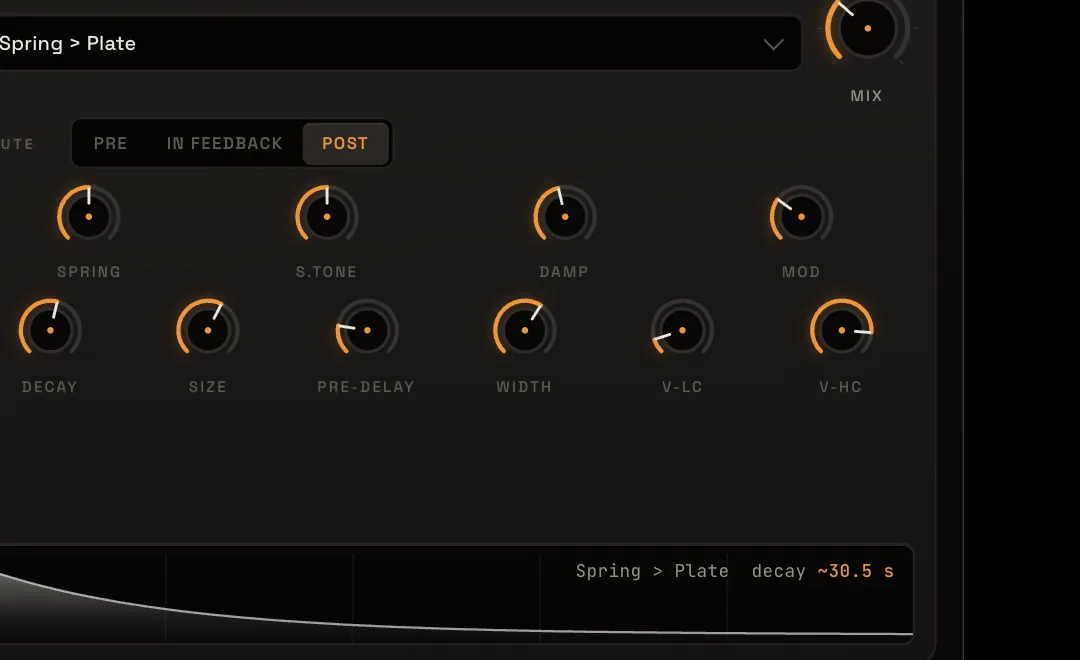
A dispersive spring tank, with the boing a real one has. A modulated plate. A dense sixteen-line hall. Spring into plate in series, and spring and plate in parallel, which are different sounds and not a preset of each other.
A shimmer, whose interval is switchable: octave up by default, or fifths, fourths, an octave down, or two octaves for something much darker or much brighter than the usual shimmer patch. And an eighties gated reverb, a bright plate behind an envelope-keyed gate, for the bloom-then-snap that every snare on every record from 1984 has.
Then convolution, which ships with forty-eight impulse responses: thirty-eight from the Voxengo set plus ten real spaces from the OpenAIR library, including York Minster, Hamilton Mausoleum and a nuclear reactor hall. It will load any impulse of your own as well.
Things that stop it hurting
A feedback path this deep will find unity gain eventually, and a tape echo screaming into a mix bus is not a charming accident when it happens during a take. So there is a slow, programme-dependent leveller on the output (the kind of gentle 2:1 you would put across a bus), followed by a fast ceiling catcher just under full scale. It keeps runaway under control without flattening transients, and it is one click to bypass if you want the mess.
The feedback knob turns red as it approaches self-oscillation, so you can see where the edge is before you hear it. Freeze holds the loop indefinitely so you can play over it. Kill feedback empties it on command. Ping-pong throws the repeats across the stereo field, and there is wet ducking so the echoes get out of the way of the dry signal.
And a bypass toggle silences the tape while leaving the whole character chain running: saturation, head bump, high-frequency loss, AGE, the phaser and the reverbs. That turns Doobie into a tape colouration insert with no delay in it at all.
Everything it does
- Four heads on one tape
- Each with its own level, pan, time and a ±200 ms nudge for width. A four-pad matrix switches taps in and out live, ramping instead of cutting, so the rhythm can be rearranged mid-take without a click.
- Five characters
- Digital for a clean repeat, Tape with wow, flutter and saturation, BBD for a dark analogue smear, Diffuse to wash the repeats out, and Pitch, which moves every repeat by an interval you set.
- A pitch shifter with its own bypass
- Anywhere from two octaves down to two octaves up on the repeats, with an on-off switch separate from the character selector, so you can A/B the interval without changing the delay underneath it.
- Play the repeats from a keyboard
- Note mode drives the pitch shifter and the shimmer reverb from MIDI: C3 unison, C4 an octave up. Pitch bend is always live, and portamento up to two seconds glides between chords instead of stepping.
- A six-stage phaser that goes anywhere
- All-pass cascade with feedback, rate, depth, mix and a stereo offset, routable before the delay, across the wet echoes, or inside the feedback loop, where every repeat sinks further through it and high feedback turns it flange-like.
- Nine reverbs, and they route too
- Spring, plate, a sixteen-line hall, shimmer with a switchable interval, series and parallel combinations, convolution with 48 impulse responses, and an eighties gated plate — placeable before the delay, after it, or inside the loop.
- Two tone stages, not one
- An input filter that shapes only what reaches the tape, and a separate feedback filter that darkens each repeat on the way round, with a resonant multimode filter in front that sweeps into self-oscillation.
- A tape saturator with the delay off
- Switch the delay to bypass and the tape buffer goes silent while the whole character chain keeps running: saturation, head bump, high-frequency loss, AGE, the phaser and the reverbs.
- It will not run away with your bus
- A slow programme-dependent leveller and a fast ceiling catcher keep self-oscillation under control without crushing transients, and the feedback knob reddens as it approaches the edge.
Specifications
| Type | Tape delay and reverb |
|---|---|
| Playback heads | 4, each with level, pan, time and ±200 ms offset, switchable live |
| Delay time | 20 ms to 8 s free; 1/64 to 4 bars synced, dotted and triplet; 16 s buffer |
| Characters | Digital, Tape, BBD, Diffuse and Pitch |
| Pitch shifter | −24 to +24 semitones on the repeats, with its own bypass for A/B |
| Playable | Note mode for the pitch shifter and shimmer, pitch bend, portamento to 2 s |
| Tone | Separate input and feedback filter stages, plus a resonant low-pass, high-pass or band-pass before the tape |
| Phaser | Six-stage all-pass with feedback, rate, depth, mix and stereo offset |
| Phaser routing | Before the delay, inside the feedback loop, or on the wet echoes only |
| Reverbs | Spring, plate, hall, shimmer, spring→plate series, spring+plate parallel, convolution, gated |
| Shimmer interval | Octave up, fifths, fourths, octave down or two octaves |
| Reverb routing | Before the delay, after it, or inside the feedback loop |
| Impulse responses | 48 bundled including OpenAIR spaces; loads your own WAV, AIFF or FLAC |
| Modulation | Two LFOs and an envelope into an eight-slot matrix, drawn on the controls |
| Performance | Ping-pong, freeze, kill feedback, wet ducking, stereo width, delay bypass |
| Output | Programme-dependent leveller and ceiling catcher, bypassable |
| Presets | 138 across dub, ambient, rhythmic, lo-fi, hall and sound design |
| Formats | VST3 · AU · CLAP · Standalone |
| Systems | macOS · Windows · Linux |
| Current release | v0.25.0, 2026-07-04 |
Screens
Captured from the running plugin.
Download
Current release v0.25.0, 2026-07-04. macOS builds are not notarised yet — right-click the plugin and choose Open the first time.