Spice FX
Saturation and cabinets
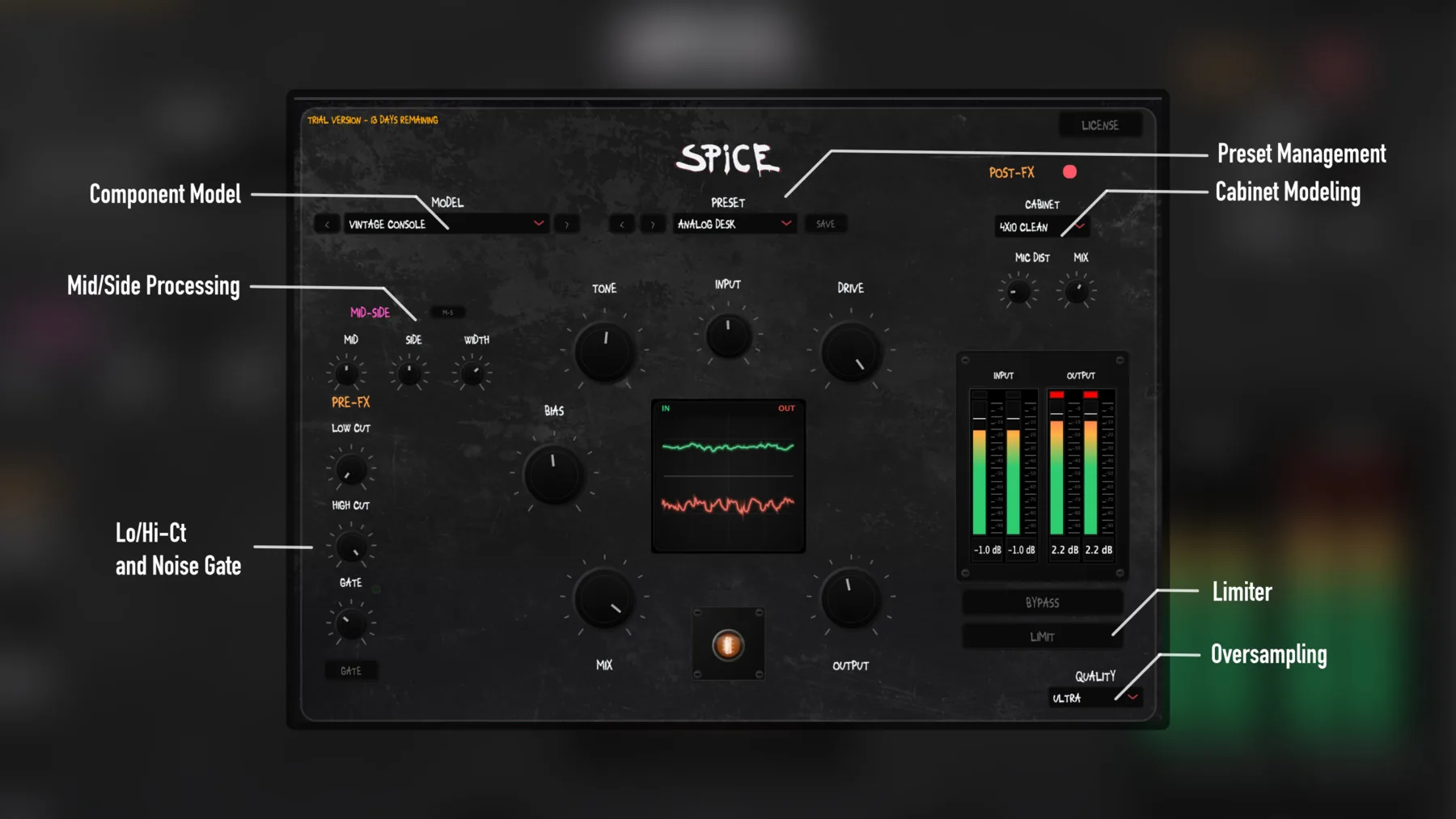
Most saturation plugins have one curve and a lot of labels. Spice has ten different transfer characteristics, so the models actually sound like different things and not like the same thing turned up.
- Type
- Saturation and cabinet
- Formats
- VST3 · AU · LV2
- Systems
- macOS · Windows · Linux
- Version
- Source
- Licence
- BSD-3-Clause
Measured figures
- 10 curves
- Ten separate transfer characteristics, not one curve at ten different gains.
- 26 dB
- Of alias rejection at 4×, measured against 1× and not assumed.
- 1.5 dB
- What that same measurement read before it caught the half-band branch-order bug.
- 10 cabinets
- Following the saturation stage, for guitar, bass and drum work.
Ten curves, not one
Tube, transistor, transformer, tape, diode, germanium, FET, op-amp, fuzz and ribbon. Each of those is a different transfer characteristic. That is the part that decides what a saturator actually sounds like: which harmonics appear, in what order, and how they behave as you push harder.
Change the curve and you change the harmonic signature. Change only the gain, as a lot of plugins quietly do behind ten different names, and you have one saturator with a decorated menu. After the saturation stage there are ten cabinet models, a noise gate, a limiter and auto-gain compensation, so a heavy setting does not simply arrive louder.
Mid-side processing lets you dirty the centre of a mix and leave the sides alone, or the reverse. That is the difference between a bus that has been thickened and a bus that has been smeared.
Why the oversampling is worth mentioning
Any saturator generates harmonics above the sample rate, and those fold back down as inharmonic rubbish unless you oversample properly. Almost every plugin claims to. Very few publish a number, because the failure mode is silent: the audio still passes, the levels look right, the harmonics look right, and the aliasing is simply still there.
The test harness here measures the folded residue directly, at one times against four. That is how a real bug surfaced: the branch ordering in the half-band filter was wrong, so the oversampler was doing almost nothing. It measured as one and a half decibels of improvement when it should have measured twenty-six. Fixed, it measures twenty-six.
A listening test would never have found that. It is the clearest example I have of why the measurement pass exists.
Open sourced
Spice was released as open source in 2025 under a BSD licence, which is about as permissive as licences get. The CMake build produces VST3, AU and LV2, and the DSP is there to read if any of the above is useful to you.
Everything it does
- Ten transfer curves
- Tube, transistor, transformer, tape, diode, germanium, FET, op-amp, fuzz and ribbon, each with its own characteristic, not a shared curve at a different gain.
- Cabinets after the drive
- Ten cabinet models following the saturation stage, for guitar, bass and drum work.
- Mid-side
- Saturate the centre and leave the sides clean, or the other way round.
- Alias rejection you can check
- The oversampler is measured against its own output at 1× instead of being assumed to work. 26 dB down at 4×, and the number comes from a test, not a marketing page.
Specifications
| Type | Saturation and cabinet |
|---|---|
| Saturation models | Tube, transistor, transformer, tape, diode, germanium, FET, op-amp, fuzz, ribbon |
| Cabinets | 10 models after the saturation stage |
| Stereo | Mid-side processing: centre and sides independently |
| Oversampling | Up to 4×, measured at 26 dB of alias rejection |
| Also in the chain | Noise gate, output limiter, auto-gain compensation |
| Presets | Over 50 factory settings |
| Licence | BSD-3-Clause |
| Formats | VST3 · AU · LV2 |
| Systems | macOS · Windows · Linux |
Build it
Spice FX ships as source. The CMake build produces VST3, AU and LV2.