Innertia Audio
Innertia Audio · Berlin

If you want to know
how an instrument
behaves, build one.

Instruments, effects and audio hardware, made in Berlin.

Instruments
Epi · Doobie · Jove · Didge · Klangschale · Spice FX
Formats
VST3 · AU · CLAP · Standalone
Systems
macOS · Windows · Linux
Hardware
AudioBus · MPE controller
EpiThe tine workshop: re-cutting the steel of all eighty-eight notes
01

Instruments and effects

Six plugins, in every major format, on every major platform.

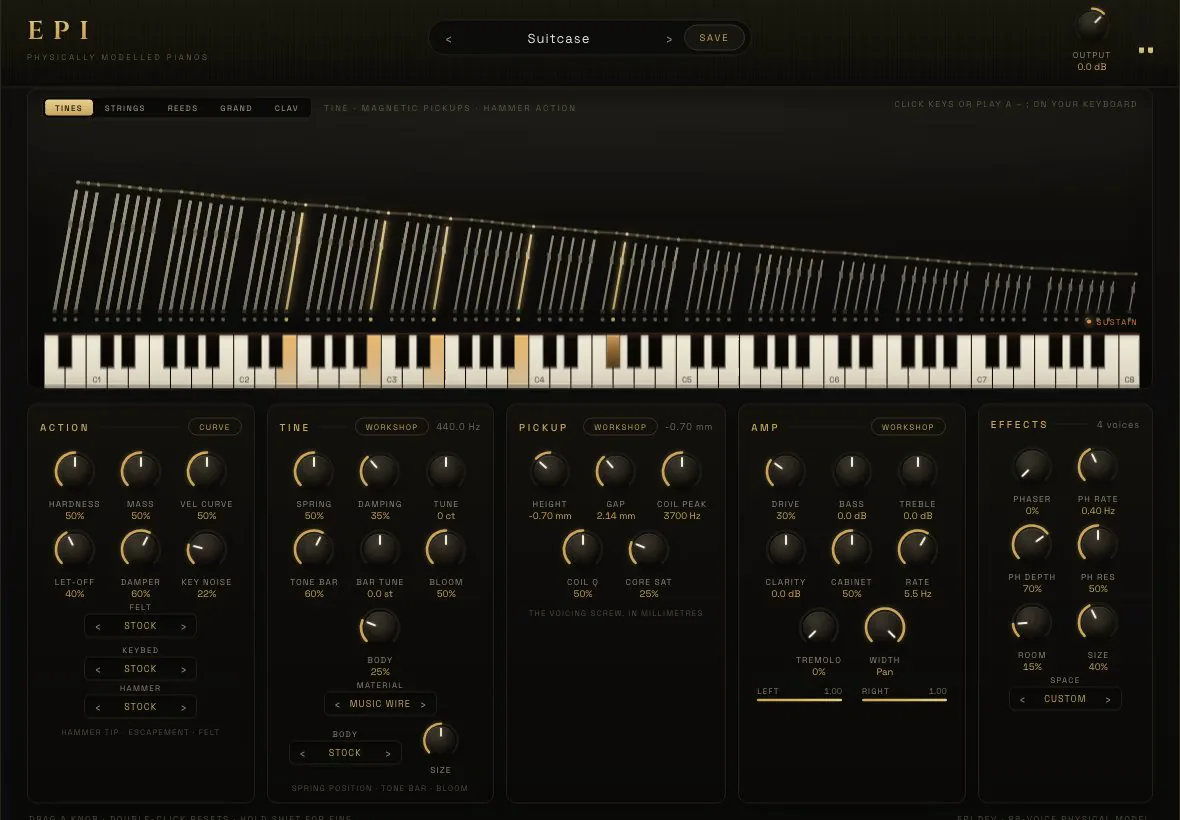
Epi playing the tine piano: the drawn keyboard, the string bank above it, and the action, tine, pickup and amp sections
01Epi — five modelled keyboards

Epi

Five modelled keyboards

A tine piano, an electric grand, a reed piano, an acoustic grand and a clav, each built from the mechanism, not recorded from it. Lean on a note and the colour changes, not the volume alone, because the model is doing what the steel does.

  • Five instruments
  • 88 voices each
  • Sympathetic resonance
  • Workshops
  • Microtonal tuning
  • Try it in a browser
FormatsVST3 · AU · CLAP · Standalone
SystemsmacOS · Windows · Linux
Versionv0.9.0 · 2026-09-01
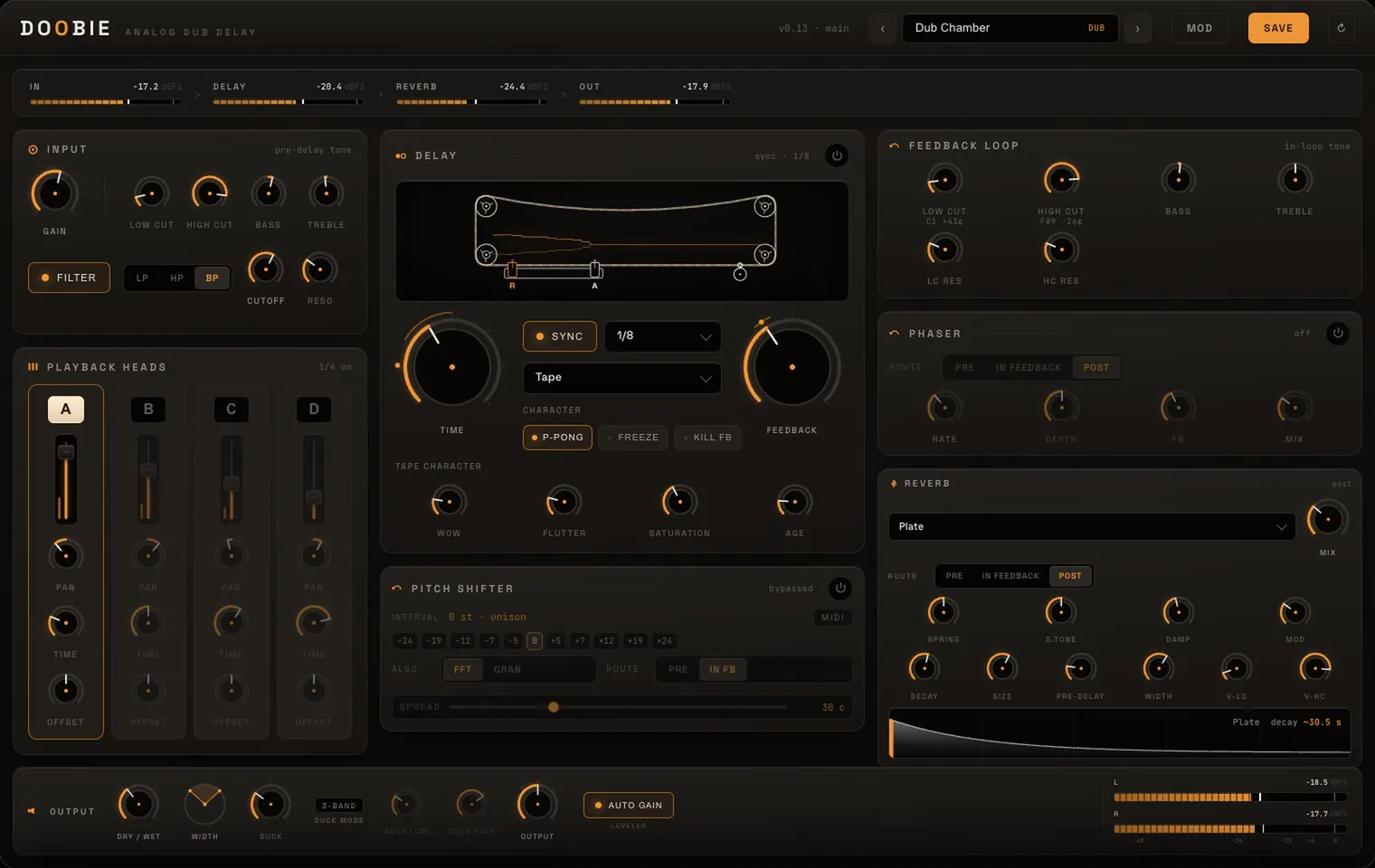
The Doobie interface: the tape transport with its reels and head block, four playback head faders, the delay and filter sections, and the reverb panel
02Doobie — multi-head tape echo, spring and plate

Doobie

Multi-head tape echo, spring and plate

Four playback heads moving over one piece of tape, five delay characters including a playable pitch shifter, a six-stage phaser and nine reverbs. Almost all of it can be placed before the delay, after it, or inside the feedback loop, which is where dub lives.

  • Four tape heads
  • Five characters
  • Pitch shifter
  • Six-stage phaser
  • Nine reverbs
  • Routable feedback
FormatsVST3 · AU · CLAP · Standalone
SystemsmacOS · Windows · Linux
Versionv0.25.0 · 2026-07-04
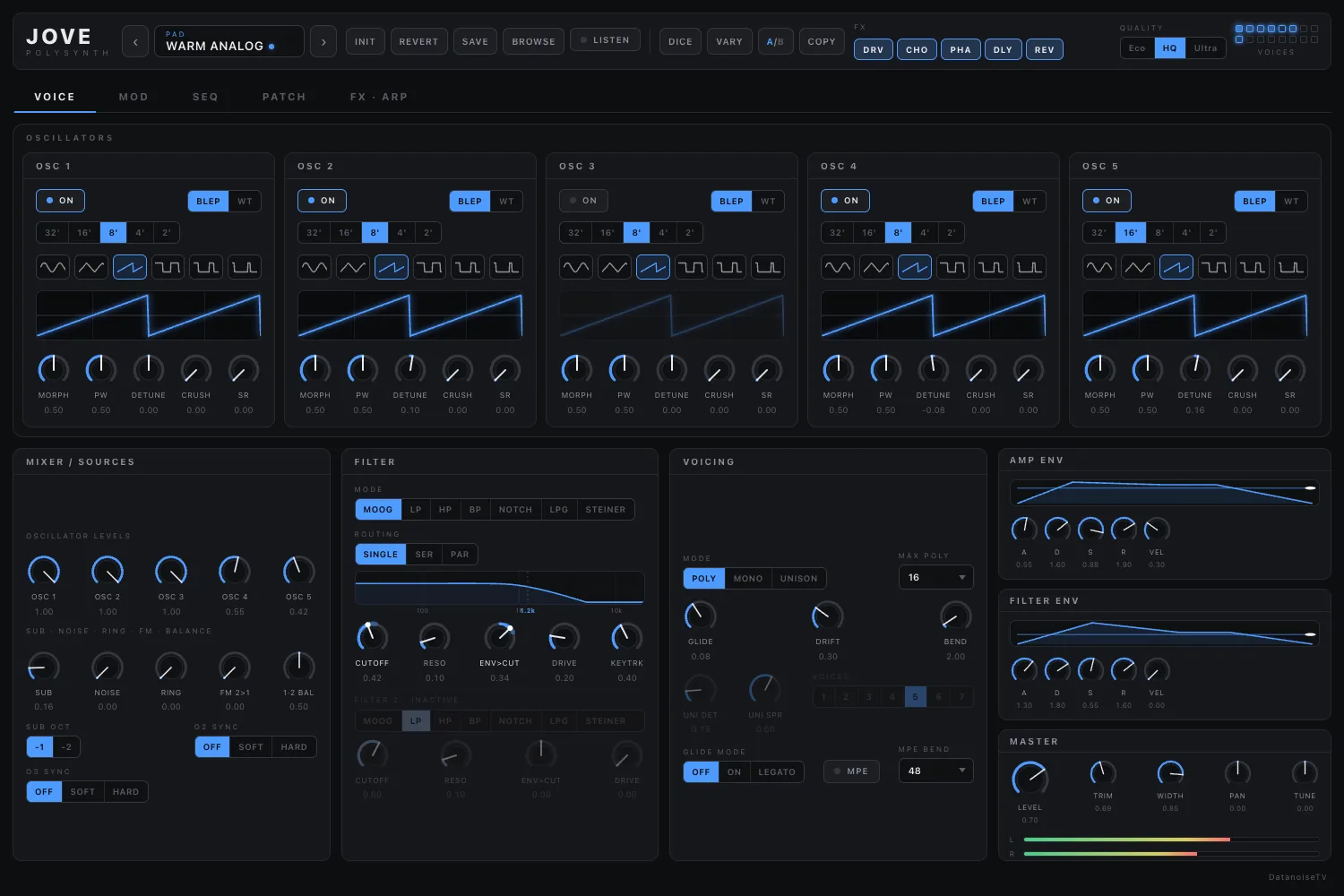
The Jove voice page: five oscillators with their waveform displays, sub and noise, the mixer, and the filter and voicing sections
03Jove — polysynth with a patchbay

Jove

Polysynth with a patchbay

Five oscillators and seven filter models behind an EMS-style patchbay that rewires the voice itself instead of offering you a routing menu. MPE throughout, and a preset bank you can browse by ear without reaching for the gain.

  • Five oscillators
  • Seven filters
  • Patchbay
  • 32-slot matrix
  • Four sequencers
  • MPE
FormatsVST3 · AU · Standalone
SystemsmacOS · Windows · Linux
Versionv1.1.1 · 2026-07-19
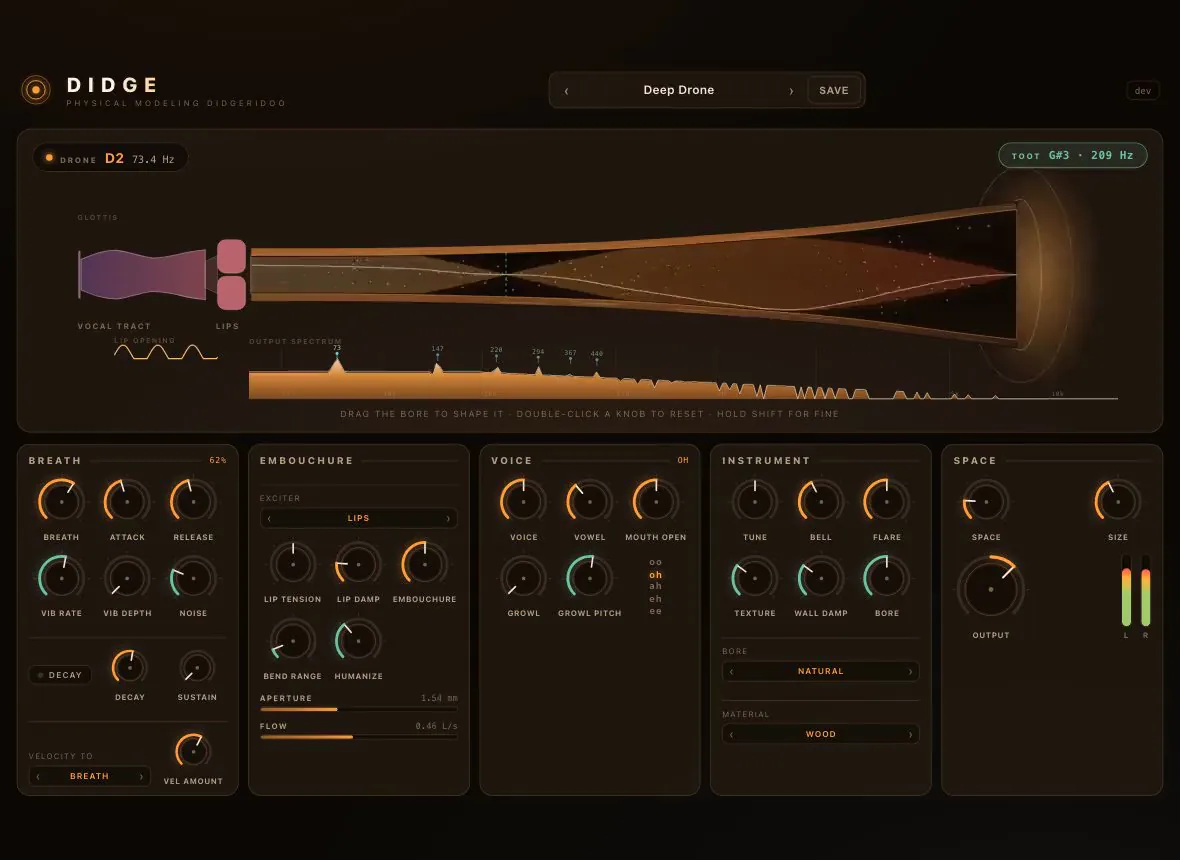
The Didge interface: the vocal tract and lip valve on the left, a bore cross-section you can drag to reshape, the live output spectrum, and the breath, embouchure, voice, instrument and space panels
04Didge — a wind instrument you assemble

Didge

A wind instrument you assemble

Lungs drive a vocal tract, the tract drives a lip valve or a reed, and that drives a bore that radiates from its bell. Choose the exciter and the bore separately and it is a clarinet, a recorder, a trumpet, a tuba, an alphorn, a didgeridoo, or something with no name at all.

  • Five exciters
  • Twelve bores
  • Vocal tract
  • Draggable bore
  • Circular breathing
FormatsVST3 · AU · CLAP · Standalone
SystemsmacOS · Windows · Linux
VersionIn development
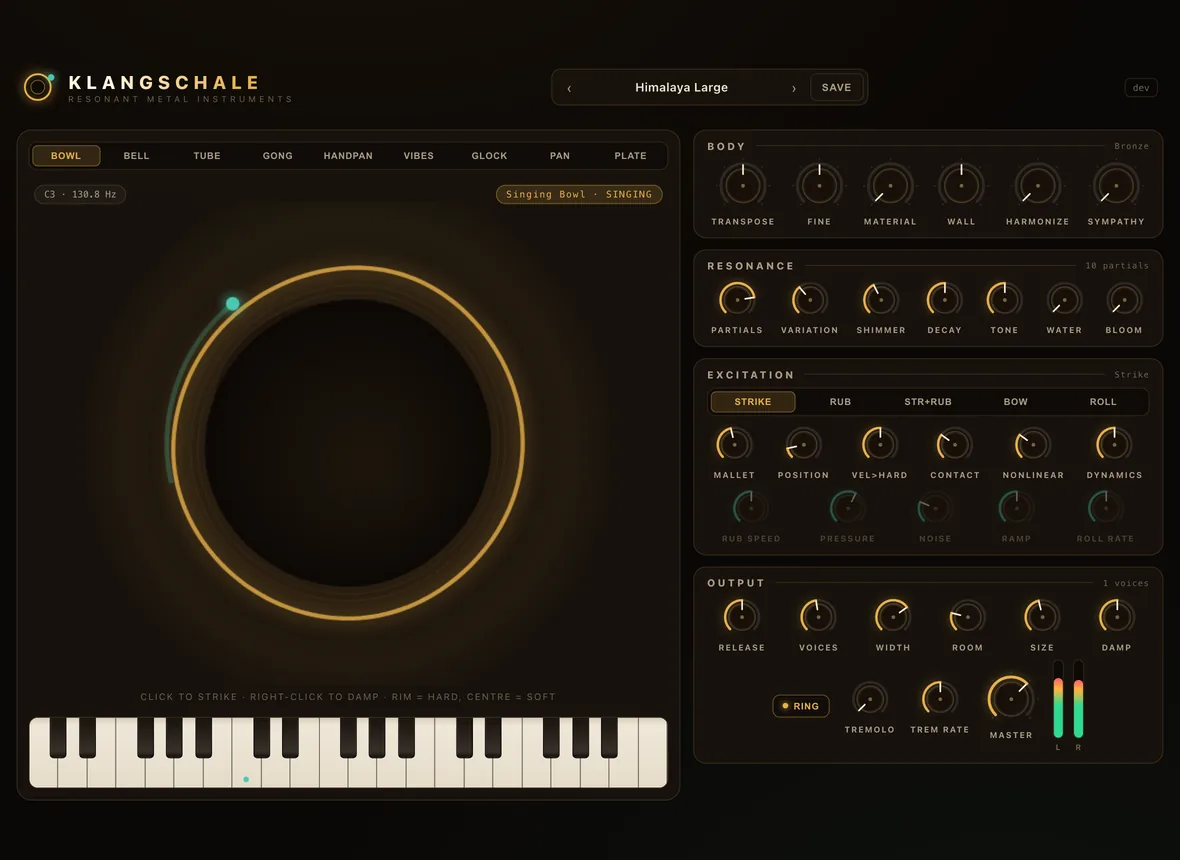
Klangschale playing a singing bowl: the live resonator with its orbiting puja, the nine instrument tabs, and the body, resonance, excitation and output panels
05Klangschale — resonant metal, struck, rubbed and bowed

Klangschale

Resonant metal, struck, rubbed and bowed

Nine metal bodies (singing bowls, church bells, tubular bells, gongs, handpans, vibes, glockenspiel, steelpan and tam-tam) with real stick-slip friction, so a bowl rubbed with a puja builds and sings and limits itself the way one actually does.

  • Nine bodies
  • Stick-slip friction
  • Strike, rub, bow, roll
  • 16 voices
  • MPE expression
FormatsVST3 · AU · CLAP · Standalone
SystemsmacOS · Windows · Linux
VersionIn development
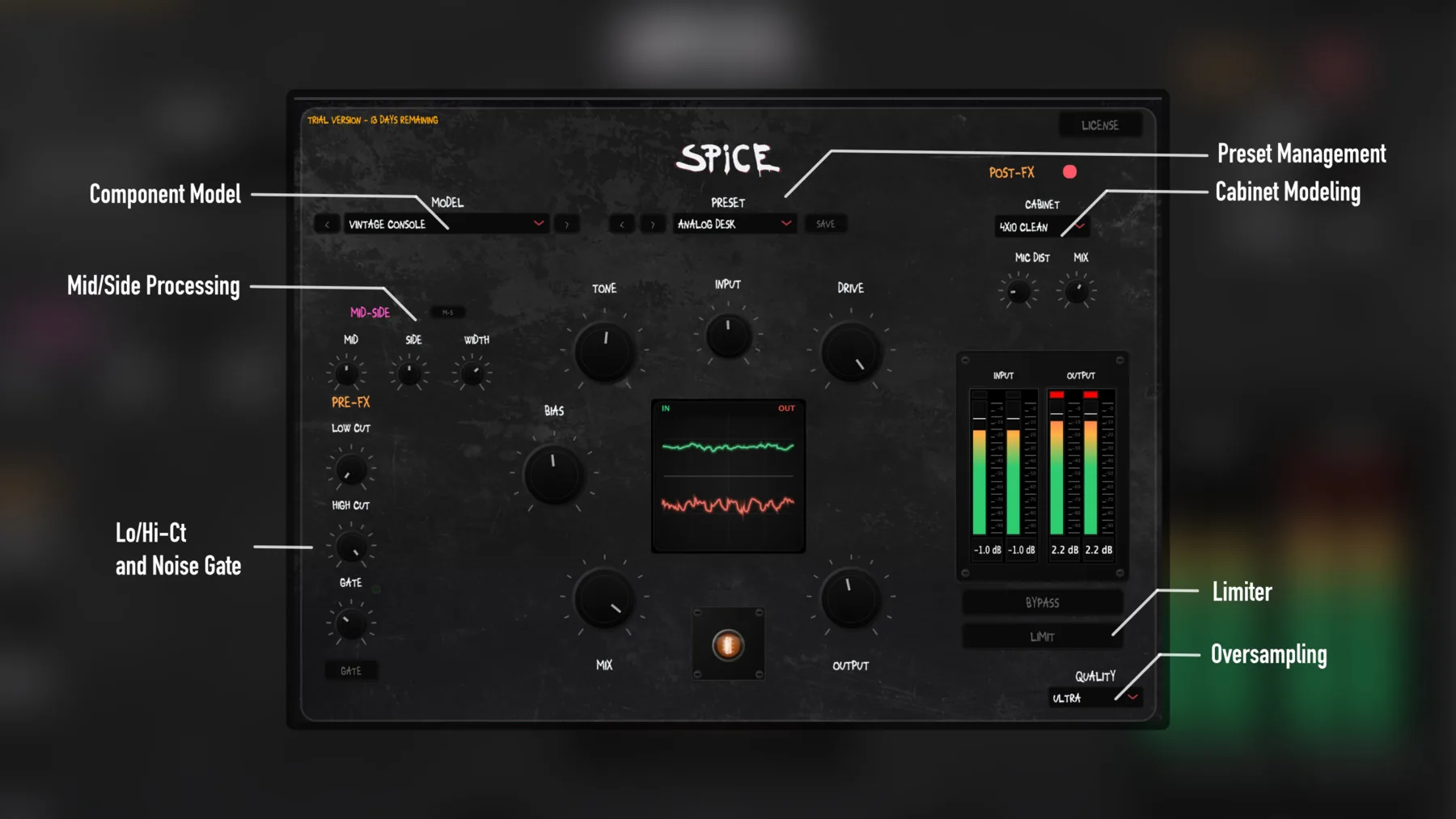
The Spice FX interface: the saturation model selector, drive and tone controls, and the cabinet section
06Spice FX — saturation and cabinets

Spice FX

Saturation and cabinets

Ten saturation models with ten separate transfer curves, not one curve at ten gains, plus cabinets, mid-side processing and oversampling whose alias rejection was measured and not assumed. Open sourced in 2025.

  • Ten saturation models
  • Ten cabinets
  • Mid-side
  • 4× oversampling
FormatsVST3 · AU · LV2
SystemsmacOS · Windows · Linux
VersionIn development
02

Faceplate

The audio UI component library the panels above are being rebuilt on. Fifty-seven components for plugin panels and for the browser.

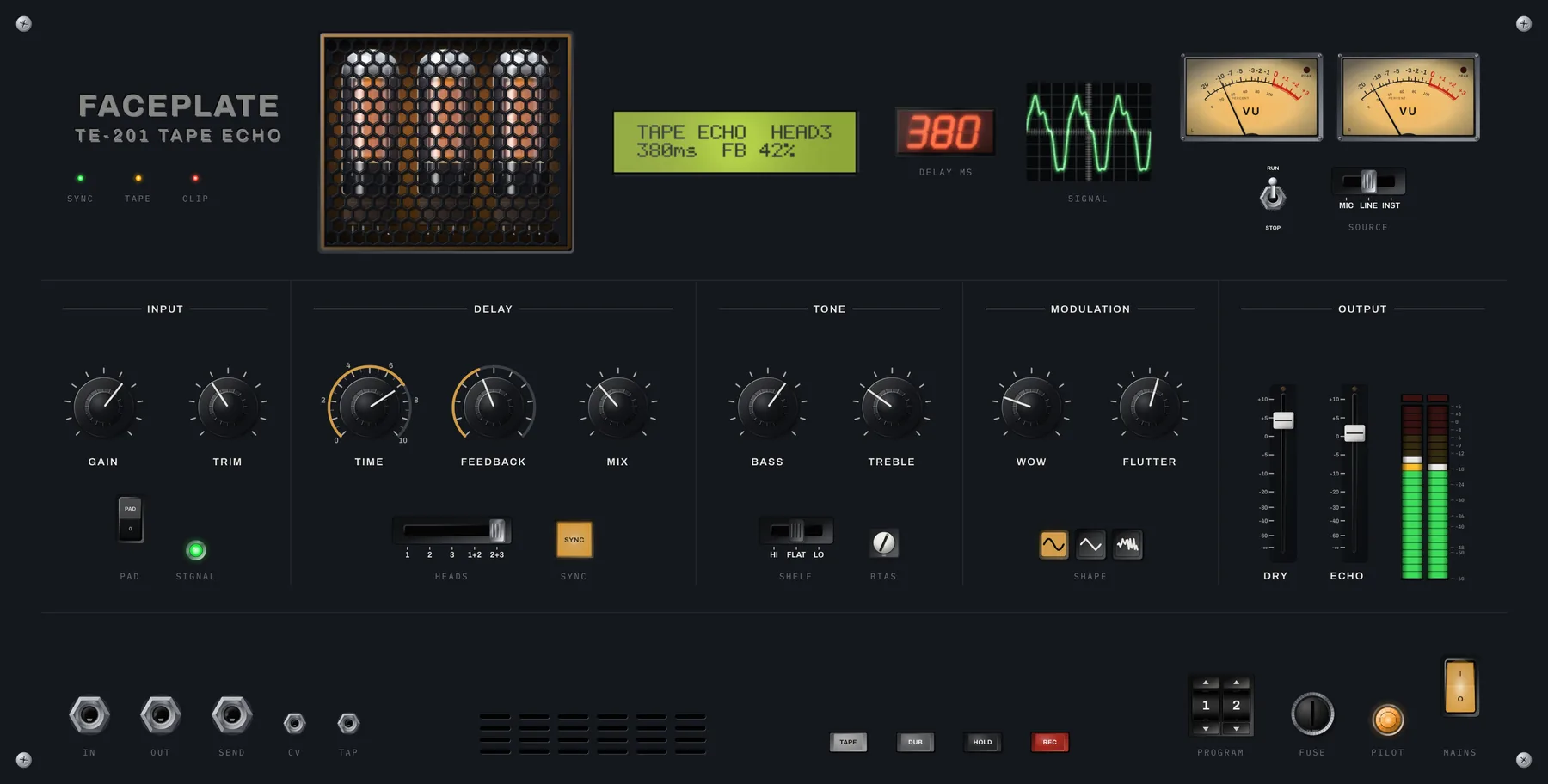
A panel built entirely from Faceplate elements: an engraved nameplate, knobs with skirt scales, a VU pair, a character display, illuminated buttons and a valve window
02Faceplate — one panel, built from the parts

Faceplate

Audio UI component library

Every knob, switch, lamp, meter and display an audio interface needs, each drawn from the part it is named after, lit by one shared light and restyled by changing a handful of colours.

  • 57 components
  • 12 knob designs
  • 5 themes
  • No dependencies
  • Plugin and browser
03

Also from the studio

Software for performing and broadcasting, alongside the instruments.

audiovis

Live visuals

A live, audio-reactive visualiser for performance: eighteen generated looks driven by the music, controlled over MIDI, OSC or a web surface. Runs on a laptop or headless on a board small enough to live inside an instrument.

MiniKeys

MIDI controller for macOS

A virtual keyboard and control-surface builder. Play from the computer keyboard or mouse, build custom controls, then route everything through an arpeggiator, chord engine, quantiser or scale filter before it reaches the DAW.

gener8

Generative soundscapes

Water, sea, rain, wind, fire and birdsong, modelled instead of looped, so it never repeats. Opens in a browser tab. No samples, no network, nothing to install.

SideWinder FF2 for VCV Rack

Force-feedback joystick module

A VCV Rack module that patches a force-feedback joystick into a modular rack in both directions. Axes, hat and buttons arrive as CV and gates, and CV drives the motors back, so a patch can push against your hand while you play it.

TinyIce

Streaming server

A broadcast server for internet radio: audio and video, Icecast-compatible, with live ingest, transcoding, relaying, an AutoDJ and an admin interface. One binary, deployed in minutes.

04

Hardware

Open boards and transports for instruments that stand on their own, without a computer in the signal path.

AudioBus

Multichannel audio transport

Up to 64 channels of 32-bit audio, plus MIDI and control data, down a single twisted pair. Daisy-chainable, self-clocking and deterministic, built from parts that cost a couple of euros instead of proprietary silicon. For distributed instruments, multi-speaker installations and modular systems that need to stay in sample lock.

MPE touch controller

Expressive keyboard

A multitouch MPE keyboard on a seven-inch panel: two rows of keys with snap-to-pitch, glide, slide and pressure, streaming RTP-MIDI and OSC over wifi to anything on the network. The touch layer runs at 250 Hz so expression tracks the finger and not the frame rate.

05

What I build

Physical modelling, analogue and tape emulation, studio-standard networking, embedded DSP, and a measurement pass behind every release.

01 Physical modelling Instruments computed from their own mechanics, at full polyphony, in real time.
02 Analogue and tape emulation Circuits and transports modelled as circuits and transports.
03 Audio over IP and studio standards AES67, AES70, ADAT and MIDI 2.0 running on hardware an order of magnitude smaller than usual.
04 Embedded DSP Instruments that are the hardware, not a computer pretending to be one.
05 Measurement Claims are tested before they are made.