Epi
Five modelled keyboards
The electric pianos have been sampled to death. What a sample cannot give you is the part that made those instruments worth playing in the first place: the way the tone moves under your hands.
- Type
- Physical modelling
- Formats
- VST3 · AU · CLAP · Standalone
- Systems
- macOS · Windows · Linux
- Version
- v0.9.0 · 2026-09-01
- Licence
- GPL-3.0
Measured figures
- −19 dB
- How loudly a held octave answers a struck note. Measured, not chosen.
- 57.15 mm
- Where the bass hammer strikes, straight off the service manual.
- 1.3 kHz
- Where the grand’s soundboard stops behaving like a set of modes.
- 5.99 dB
- Level lost per doubling of microphone distance, matching the inverse-square law.
- 0.6 dB
- How far the default velocity curve sits from the measured piano literature.
- 34%
- Of one core at 48 kHz for a ten-note chord on the grand with the pedal down.
Why not samples
A tine piano makes its harmonics in the pickup, not in the metal. That is the whole trick of the instrument, and it is why the little voicing screw on a real one changes its entire character, and why leaning into a note makes it growl instead of simply getting louder.
A sample cannot do that. It has one answer per velocity layer and it gives you that same answer every time you ask. You can stack layers until the library is forty gigabytes and you will still be crossfading between photographs of a sound instead of playing one.
So Epi computes the instrument. A hammer strikes a piece of steel, the steel rings, and a pickup reads its motion. Raise the pickup and the instrument re-voices exactly the way the real one does, because the model is solving the same problem the metal is.
Eighty-eight of everything
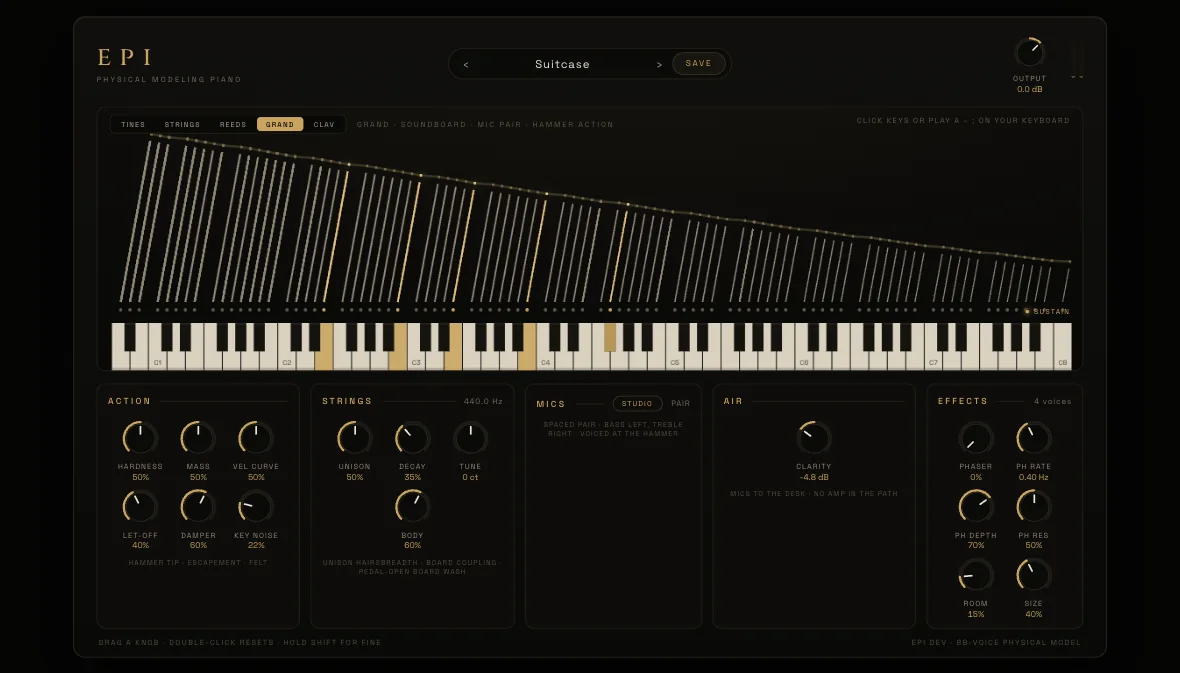
Every note runs its own hammer, its own resonator and its own pickup, all at the same time. Nothing is pooled and nothing is stolen, so a dense chord under the pedal is eighty-eight separate mechanisms doing eighty-eight separate things.
That has consequences you can hear immediately. A repeated note lands on steel that has not stopped moving, so fast repeats build instead of restarting. Hold the pedal down and the rest of the instrument answers underneath: the octave clearly, the twelfth quieter, everything else as a wash below that, at the strengths measured off real instruments, not at whatever sounded nice.
The sustain pedal is read as a position and not a switch, so half-pedalling works the way it does on an acoustic: the damper felt compresses, and the useful part of that spans the pedal’s actual travel instead of crushing into the last centimetre.
What the rest of the instrument does
Hold a chord down silently, strike a note somewhere else, and the strings you are holding answer. It is the reason a pedalled piano sounds like a room and not a stack of notes, and it is the first thing that goes missing when an instrument is sampled, because a recording of one note cannot know which other notes you are holding.
Every instrument in Epi does it, and each one does it through its own real path. On the tine piano the coupling runs through the harp. On the electric grand it runs through the bridge frame. On the reed piano it is proximity between the bars. On the acoustic grand it is the soundboard, with the whole set of strings opened when the pedal is down.
How strongly a note answers depends on how well its partials line up with the one you struck, and that hierarchy is measured, not invented: a struck note rings its octave partner about nineteen decibels down, the twelfth twenty-six down, and everything non-coincident thirty-eight down as a wash underneath. On the grand it goes further. The full course resonates, including the coupled prefixes and the slow beating between the slightly detuned strings of a single note.
The coupling only runs one way, and that was a decision, not a shortcut. A two-way spring between string and body was built, measured, and thrown away: it pumps against the string’s own Q, and on resonators that ring for seconds that is a generator waiting to happen. What is there now is passive by construction.
The nice consequence is that a lot of things nobody programmed simply appear. The boom you hear when the sustain pedal goes down is not a sample of a pedal. It is the sound of eighty-eight strings suddenly being allowed to move. The wash as the pedal lifts, and the soft shh of the dampers landing back on the strings, come out of the same place.
The body it is all mounted on
A string on its own is a thin, unconvincing sound. What you actually hear is the string through whatever it is bolted to (a harp, a frame, a soundboard, a wooden case), and that body has its own modes, its own mass and its own losses.
Epi models that as a bench you can change. Eight materials, and a size you can move continuously. Both do what physics says they should: the ladder of body modes scales with stiffness over density divided by size, the modal mass scales with density and the cube of size, and each material brings its own internal loss. Shrink the body and everything moves up and gets tighter; build it out of something lossier and the bloom dies away faster.
It applies to all five instruments: the tine’s harp, the electric grand’s frame, the reed’s frame, the acoustic grand’s soundboard and radiator, and the clav’s case. Leave it alone and you get the stock instrument, bit for bit.
The grand’s board is the elaborate one: a fitted modal soundboard, coupled to the strings through the bridge as a two-port. Above about 1.3 kHz, where a real board stops moving as a coherent thing, it hands over to a statistical radiator instead of pretending the modes still line up. And the electric grand’s famous endless sustain is not a reverb hiding behind the strings. It is the absence of a soundboard: with nothing efficient to radiate into, the string simply has nowhere to spend its energy.
Five instruments, one selector
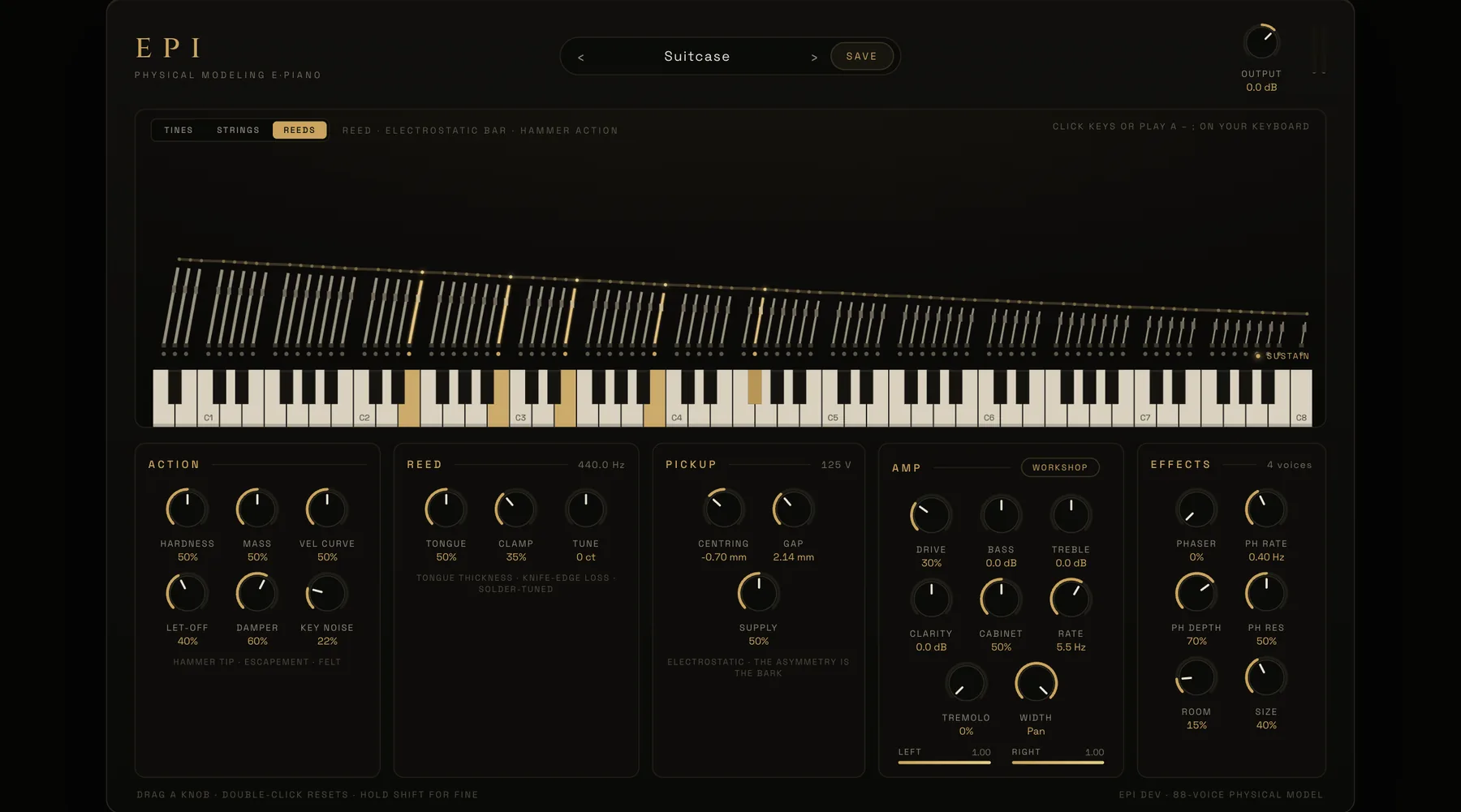
The tine piano, with its magnetic pickups and the stereo panner its amplifier insisted on calling vibrato. The electric grand, with the long singing sustain that made those things worth carrying up stairs. The reed piano, which barks when you lean on it, because the gap in its electrostatic pickup is not symmetrical and the asymmetry is the sound.
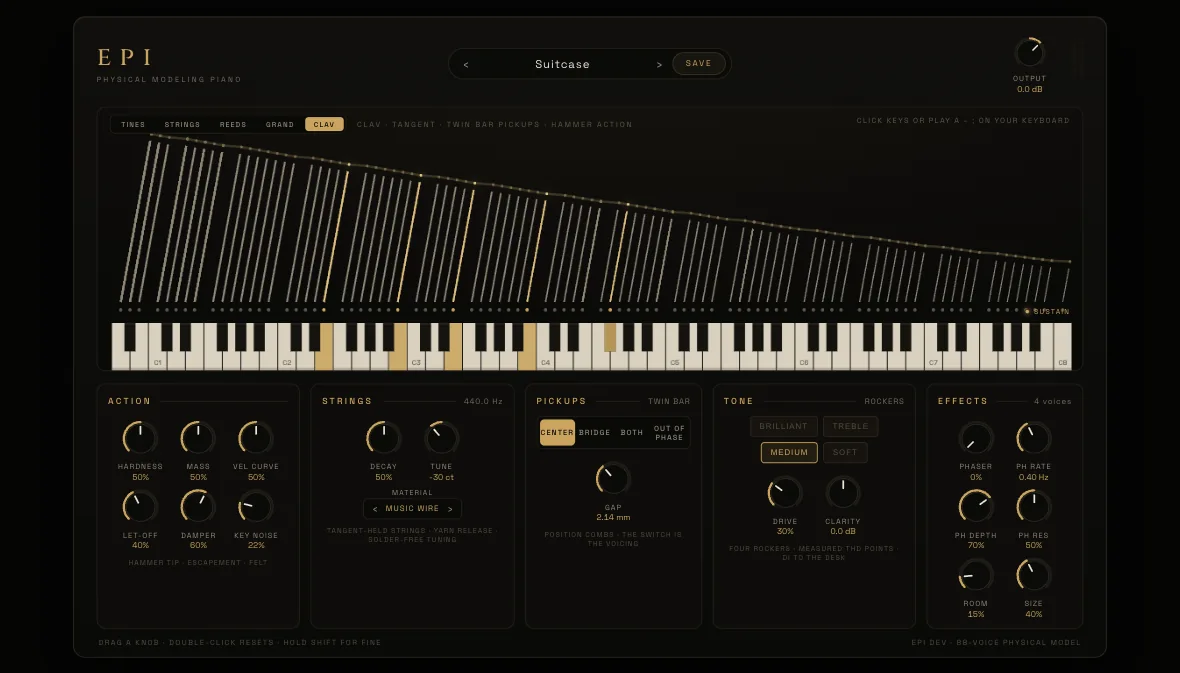
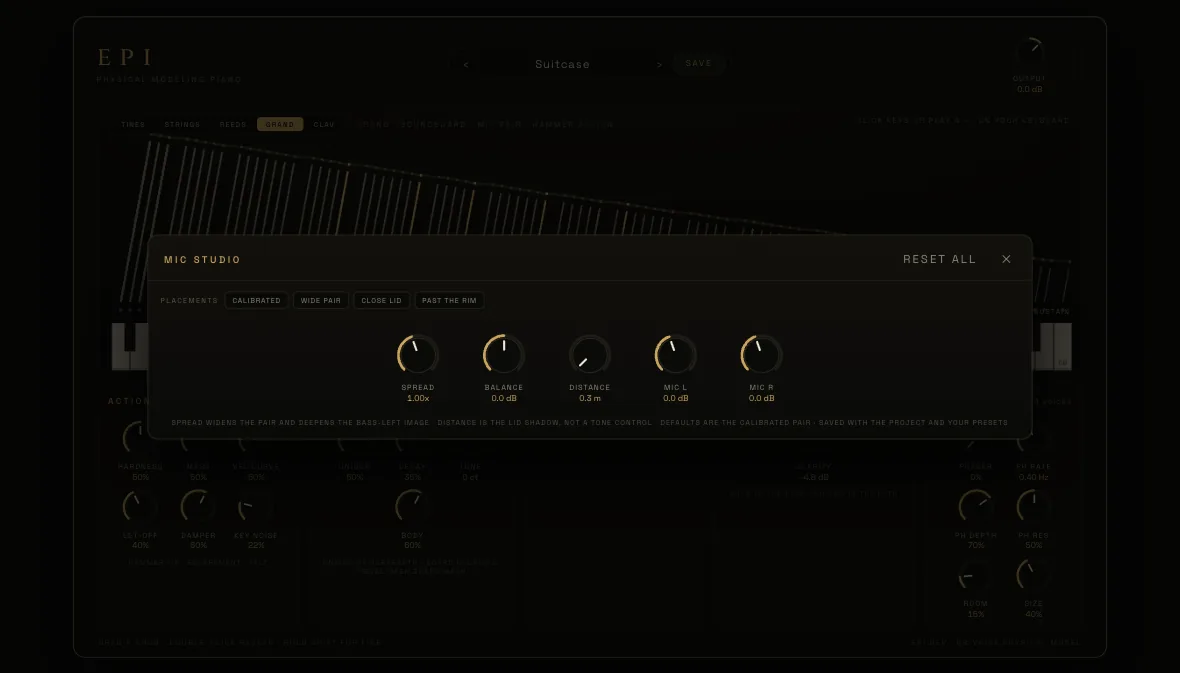
Then an acoustic grand, played through a pair of microphones you can actually move around the instrument, with the lid, the soundboard and the distance all doing what they do. And a clav, with the twin bar pickups at their measured spacing, the four tone rockers computed as the RC networks that sit behind them, and the three-semitone pitch drop you hear when the tangent lets go and the dead length rejoins the string.
They are not five presets on one engine. Each one is its own mechanism, with its own way of turning motion into a signal.
The workshops
This is the part I could not stop building. The panel gets you the classic sounds; the workshops let you take the instrument apart.
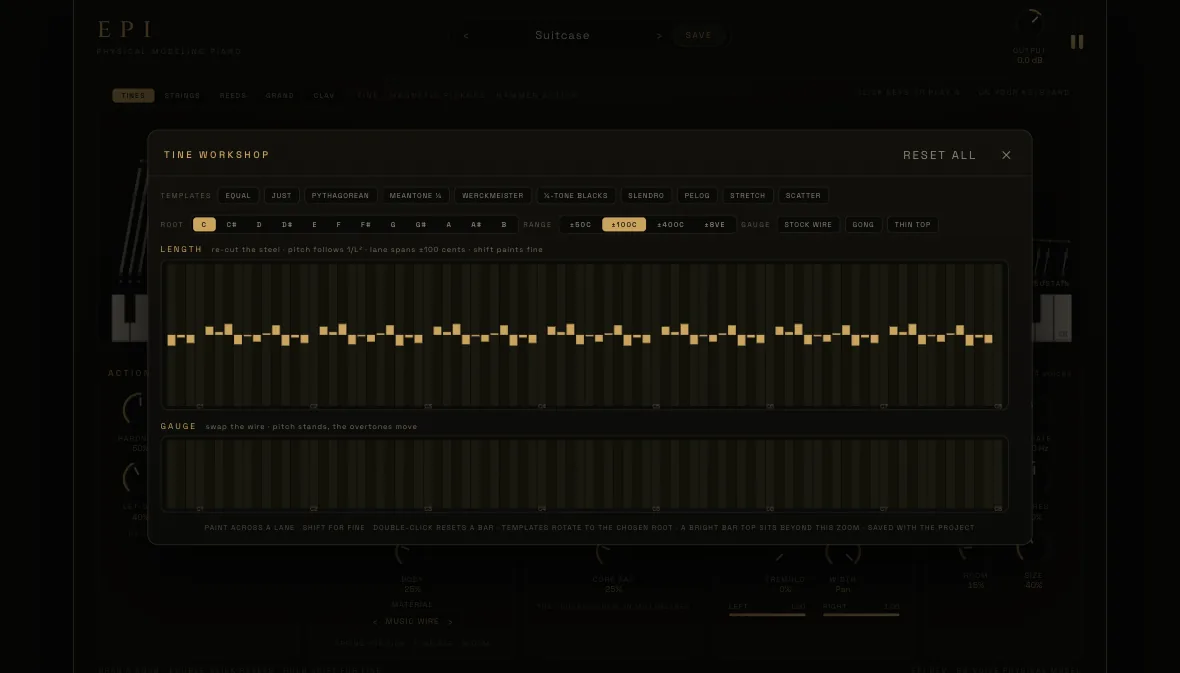
Re-cut any note’s steel and it retunes by the beam and string equations. Paint a microtonal scale in by hand, or drop just intonation, Pythagorean, quarter-comma meantone, Werckmeister III, slendro or pelog across the whole bank in one click, rotated to any root. Change the wire gauge and the pitch stays put while the overtones move. Fat wire turns the tine bank into gongs and makes the grand bell-like.
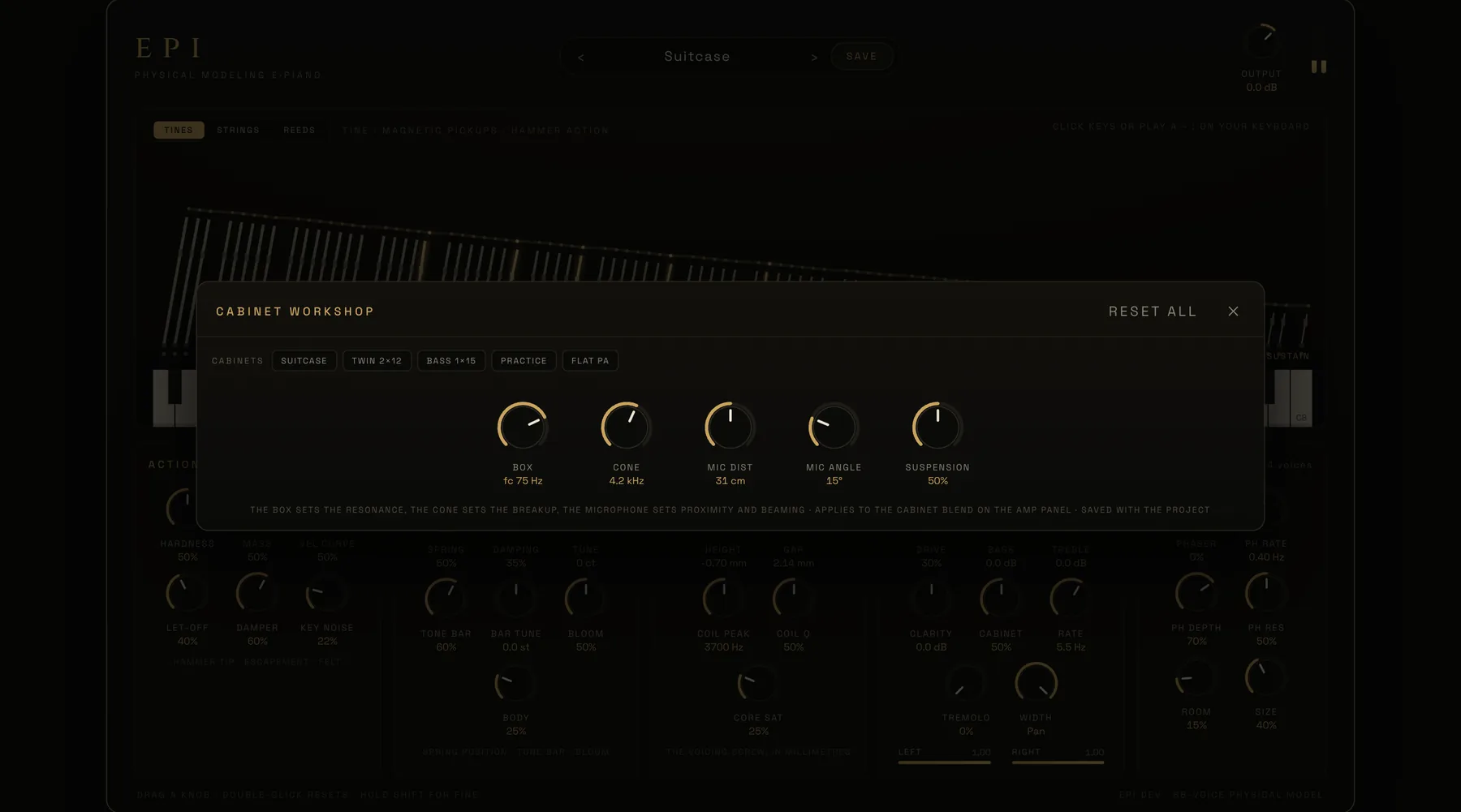
Decide how worn the pickups are, with tolerance templates that paint the manufacturing scatter of a well-kept, a worn or a neglected instrument. It is deterministic, so you get the same instrument every time you open the session. Size a speaker cabinet by its dimensions rather than loading an impulse response of one. Or drag up to five microphones around a top-down view of the grand and hear the image move, with arrival delays at the speed of sound and the lid brightening the open side.
All of it is saved inside the preset. A sound you save is the whole sound, not a panel snapshot with the real work missing.
Details that took the longest
The tine itself is very nearly a pure sine wave once the strike transient has passed. That is the published finding, and it is the thing that reorganises how you build one of these: every harmonic you associate with a tine piano is made by the pickup’s field, not by the metal. Which is why the pickup height control is not a tone knob. It is the voicing screw, doing the job the voicing screw does.
The hammers strike where the real ones strike. The line runs from 57.15 mm from the end in the bass to 3.175 mm in the treble, straight off the service manual, because where a hammer lands decides which partials it can excite at all.
The reed piano’s bark is a single asymmetry. Its pickup is a capacitor whose gap changes as the reed swings, and the response to closing the gap is not the mirror of opening it. Bypass that one nonlinearity in the model and the bark disappears completely. It is a good test of whether you have modelled the mechanism or decorated around it.
The clav drops about three semitones when the tangent lets go and the yarn-wrapped dead length rejoins the string. Everyone recognises that noise and almost nobody reproduces. And on the grand, a microphone placed under the soundboard reads the low end inverted, because a soundboard is a dipole, while the open lid throws about three and a half decibels of 2 to 6 kHz back at whatever is sitting on that side.
None of that is expensive to play. A ten-note chord on the acoustic grand with the pedal down costs about a third of one core at 48 kHz. The absolute worst case (all eighty-eight notes fortissimo with the pedal down) is under half a core. Deterministic, every time.
The honesty ledger
Epi ships with a document that lists what the models cover, what they do not cover yet, and how every claim in the first list is verified. The gaps are named alongside the physical mechanism behind each one, and they print on every test run, so none of them can quietly disappear between releases.
The constants that come from published measurements say so, and cite the paper. The ones that are calibrations say that too. Every factory sound is rendered and measured before it ships, and not only for level: a hardened-felt preset has to measure its zing, a worn keybed its thump, a parlour soundboard its thinner bottom end.
I would rather tell you where the edges are than let you find them in the middle of a session.
Why it sustains like that
A struck string is not one sound fading out. It is a stack of overtones, each falling away at its own speed — the bright ones go first, the fundamental hangs on underneath. That is why a piano note darkens as it decays instead of just getting quieter, and it is most of the difference between a piano and an organ with an envelope on it.
It is also why the top of the keyboard behaves so differently from the bottom. Damping rises with frequency, so a bass note can ring for twenty seconds while a treble note is gone in three, with fewer partials to lose on the way.
Epi computes all of that for eighty-eight notes at once, which is why holding the pedal and playing a chord builds the way it does. The plot below is drawn from the same equations the instrument uses. Click along it to strike a different note (left is low, right is high), and up or down to move the strike closer to the end of the string.
Everything it does
- Every note is its own instrument
- Eighty-eight independent hammers, resonators and pickups running at once. Chords never steal voices, and a repeated note meets steel that is still moving, so fast repeats build instead of restarting.
- Pedals that behave
- Sustain is a position, not a switch, so half-pedalling works through the damper felt the way it does on an acoustic. Sostenuto holds exactly the keys you had down. The left pedal offers both real mechanisms: sliding the grand action across the strings, or shortening the stroke like an upright.
- Real materials, real consequences
- Eight resonator materials as physical constants, not tone presets. Aluminium reads faintly through a magnetic pickup because the eddy-current law says so, and nylon — an insulator — is silent through one. Nylon still sustains, because material loss enters only through the bending part of the restoring force.
- Notes that ring each other
- Sympathetic resonance on every instrument, each through its real path: the tine’s harp, the electric grand’s bridge frame, the reed’s bar, the grand’s soundboard with the full pedal-down complement.
- Rebuild it while you play
- Retune by the beam and string equations, swap wire gauge, choose a hammer covering, set how worn the damper felt and keybed are, size a cabinet by its dimensions, or move microphones around the grand. Every one of those is a physical change, not an EQ curve in costume.
- A body you can rebuild
- Eight body materials and a continuously variable size, scaling the way plate theory says they should. Mode ladder with stiffness over density, modal mass with the cube of the size, and each material’s own internal losses. It applies to the harp, the frames, the soundboard and the case.
- Microphones with real geometry
- On the grand, up to five microphones placed anywhere on a top-down view, with level falling 5.99 dB per doubling of distance, arrival delays at the speed of sound, the soundboard’s dipole inverting the low end underneath it, and the open lid brightening its side by about 3.5 dB.
- Presets that were measured, not just auditioned
- Every factory sound is rendered and measured before release, including its character: the hardened-felt preset has to measure its zing, the worn keybed its thump.
Specifications
| Type | Physical modelling |
|---|---|
| Instruments | Tine · E-Grand · Reed · Grand · Clav |
| Voices | 88 per instrument, each an independent mechanism |
| Resonator materials | Music wire, stainless, bronze, brass, titanium, aluminium, tungsten, nylon |
| Transducers | Magnetic, electrostatic and contact, on any resonator |
| Hammer coverings | Stock, soft felt, hard felt, lacquered, leather, wood |
| Tuning | Per-note editing, historical temperaments, microtonal scales, octave stretch |
| Pedals | Continuous sustain (CC64), sostenuto (CC66), una corda (CC67, two mechanisms) |
| Microphones | Calibrated pair, or up to five placed freely around the grand |
| Control | MIDI, expression (CC11), pitch bend, computer keyboard, drawn keys |
| Presets | Factory bank across all five instruments, each one rendered and measured |
| Formats | VST3 · AU · CLAP · Standalone |
| Systems | macOS · Windows · Linux |
| Current release | v0.9.0, 2026-09-01 |
Screens
Captured from the running plugin.
Download
Current release v0.9.0, 2026-09-01. macOS builds are not notarised yet — right-click the plugin and choose Open the first time.