Jove
Polysynth with a patchbay
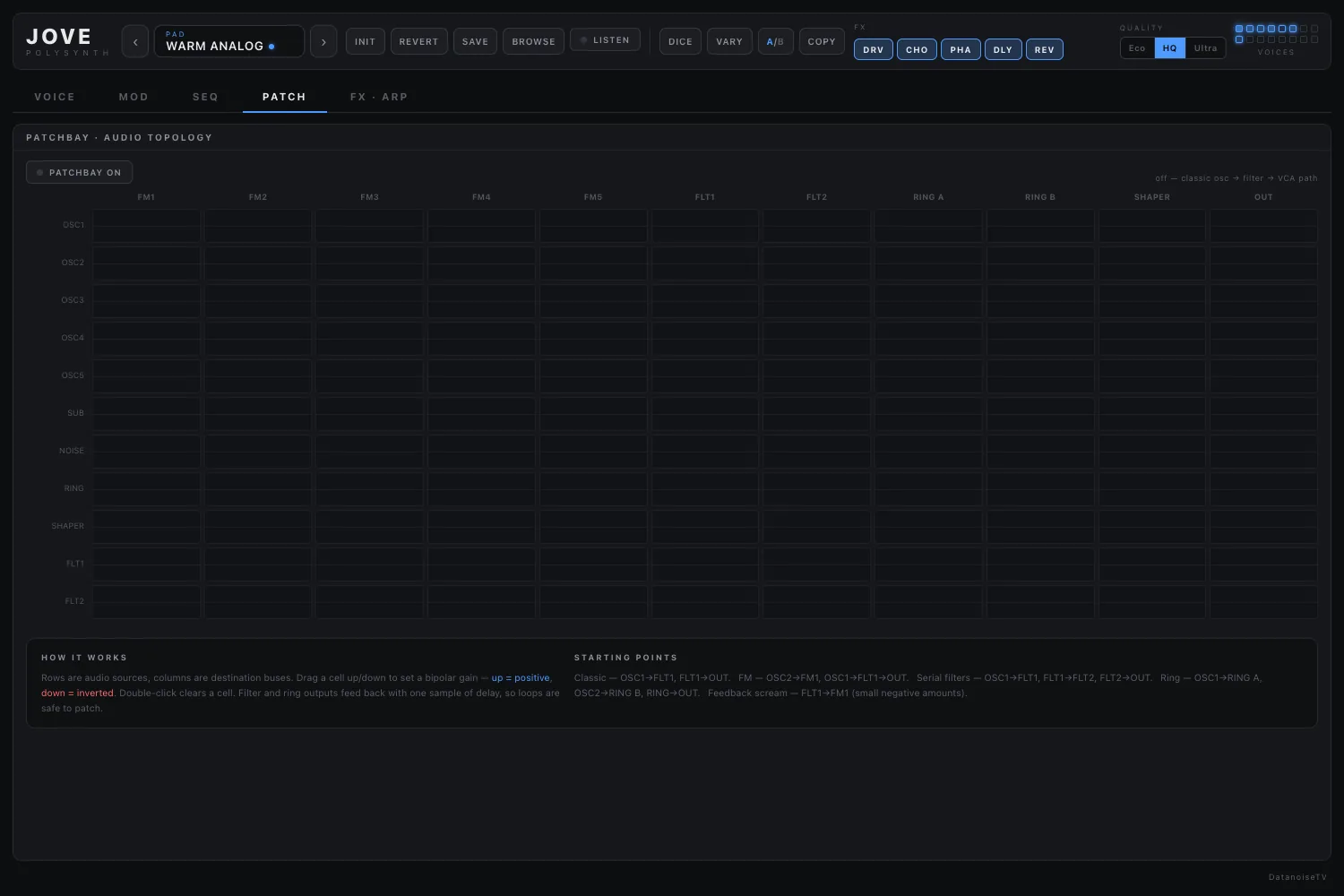
Most synths give you a fixed voice and a modulation matrix to wiggle it with. Jove lets you change what the voice is. Patch an oscillator into another one’s frequency, run the filters in series, or close a feedback loop that will not blow up.
- Type
- Virtual analogue synthesizer
- Formats
- VST3 · AU · Standalone
- Systems
- macOS · Windows · Linux
- Version
- v1.1.1 · 2026-07-19
- Licence
- GPL-3.0
Measured figures
- 11 × 11
- Patch points, bipolar, rewiring the audio path instead of offering a routing menu.
- 1 sample
- Of delay in the patchbay feedback path. It is why a patched loop cannot blow up.
- 32 slots
- Of modulation, drawn as arcs and moving dots on the knobs they are pulling.
- ±1 dB
- How closely the 140 factory patches are loudness-matched across the whole bank.
- 4×
- Oversampling of the entire voice path on the highest quality setting.
The patchbay is the point
The old EMS synths had a pin matrix instead of a signal path. You decided what connected to what, and the instrument was whatever those pins said it was. Jove has eleven source nodes crossing eleven destination buses, with a gain at every crossing that can go negative.
This is not a routing menu with a nicer skin. It rewires the actual audio path. Frequency-modulate any oscillator from any node in the instrument. Chain the two filters in series when the patch wants twenty-four more decibels of slope, or run them in parallel when it wants two characters at once. Patch the output of something back into its own input, which is safe because the loop is delayed by exactly one sample, so it can howl but it cannot explode.
Half the patches I keep came from putting a pin somewhere I had not intended and leaving it there.
Five oscillators and seven filters
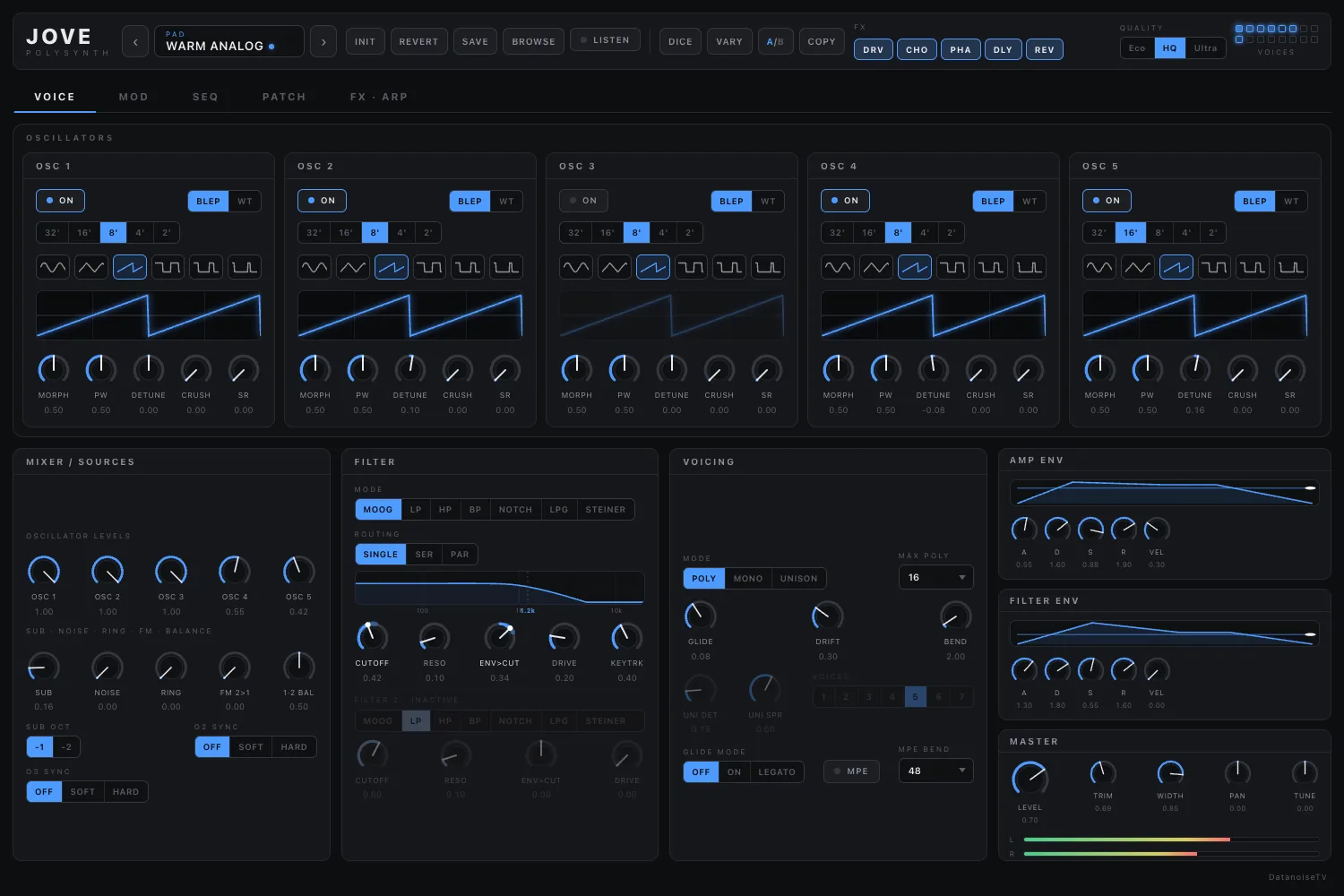
Each oscillator morphs continuously from sine through triangle and saw to pulse with variable width, band-limited so the top octave stays clean, or switches to wavetable mode and scans a bank of sixty-four tables. Each has its own footage, detune, bit-crush and sample-rate reduction, so you can dirty one voice inside an otherwise clean patch.
Underneath there is a sub oscillator an octave or two down, noise, ring modulation, oscillator-to-oscillator FM, and hard and soft sync. Unison stacks up to seven voices per note with detune and stereo spread, on top of sixteen-voice polyphony.
The filters are a Moog-style twenty-four decibel ladder, a state-variable in low-pass, high-pass, band-pass and notch, a low-pass gate for plucked and struck behaviour, and a Steiner-Parker. They are cutoff-matched to each other, which sounds like a small thing and is not: it means switching model while auditioning changes the character without changing the brightness, so you are comparing filters and not comparing levels.
Modulation you can see moving
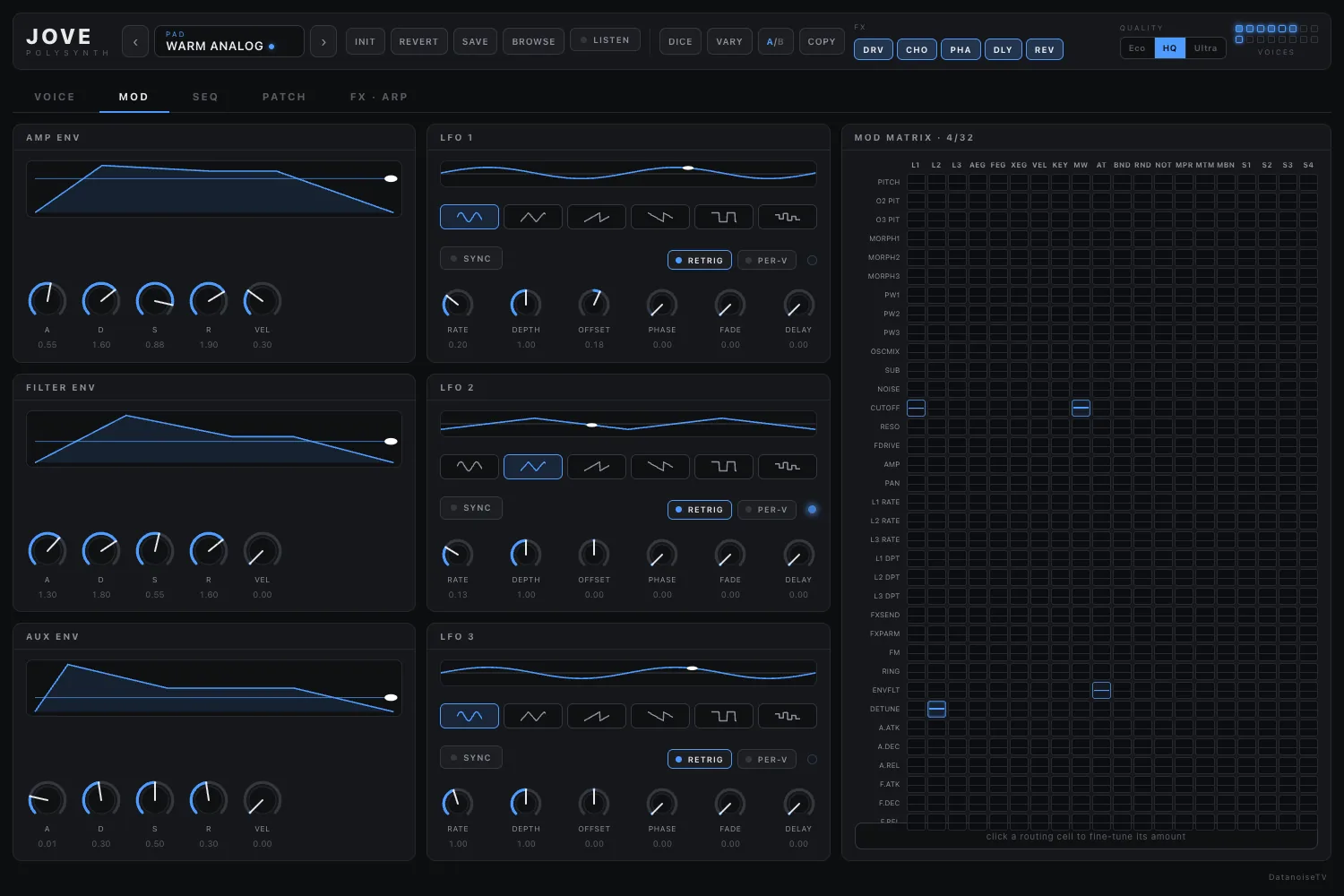
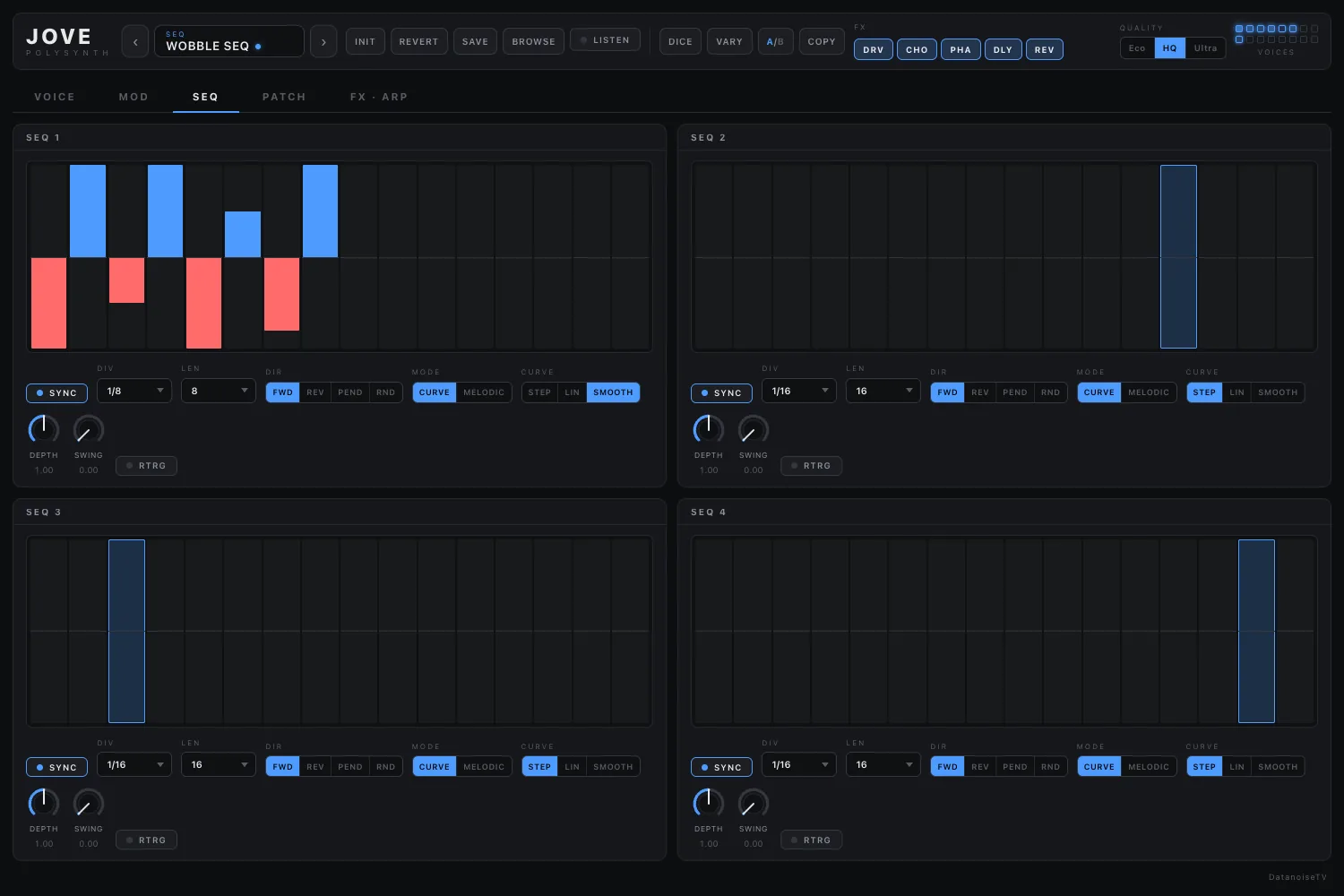
Three envelopes, three LFOs with six shapes each (tempo-syncable, with fade and delay, per voice or global), and four sixteen-step sequencers that run in melodic or curve mode with swing and direction control. All of them are sources in a thirty-two slot matrix, edited as a grid you can read at a glance.
The part I use most is that the matrix draws itself onto the instrument. Any knob that is being modulated shows the range as an arc around it and a dot moving live inside that arc. You can see the filter envelope pulling on the cutoff while you play, which turns editing from an act of imagination into an act of looking.
Getting from nothing to a sound
There are a hundred and forty factory patches in twelve categories, and they are loudness-matched across the entire bank to within a decibel. Measured, not eyeballed. Browsing the bank does not mean riding the output fader, and a patch that seems better is better and not simply louder. Each one still has a trim if you disagree.
Audition mode plays a demo phrase appropriate to the category at the host tempo, so you can go through a bank with your hands off the keyboard. And when nothing in it is right, DICE builds a new patch from a musical archetype instead of randomising every parameter into noise, while VARY perturbs what you already have. A/B compare, copy between slots, revert to the stored preset, and an indicator when there are unsaved edits.
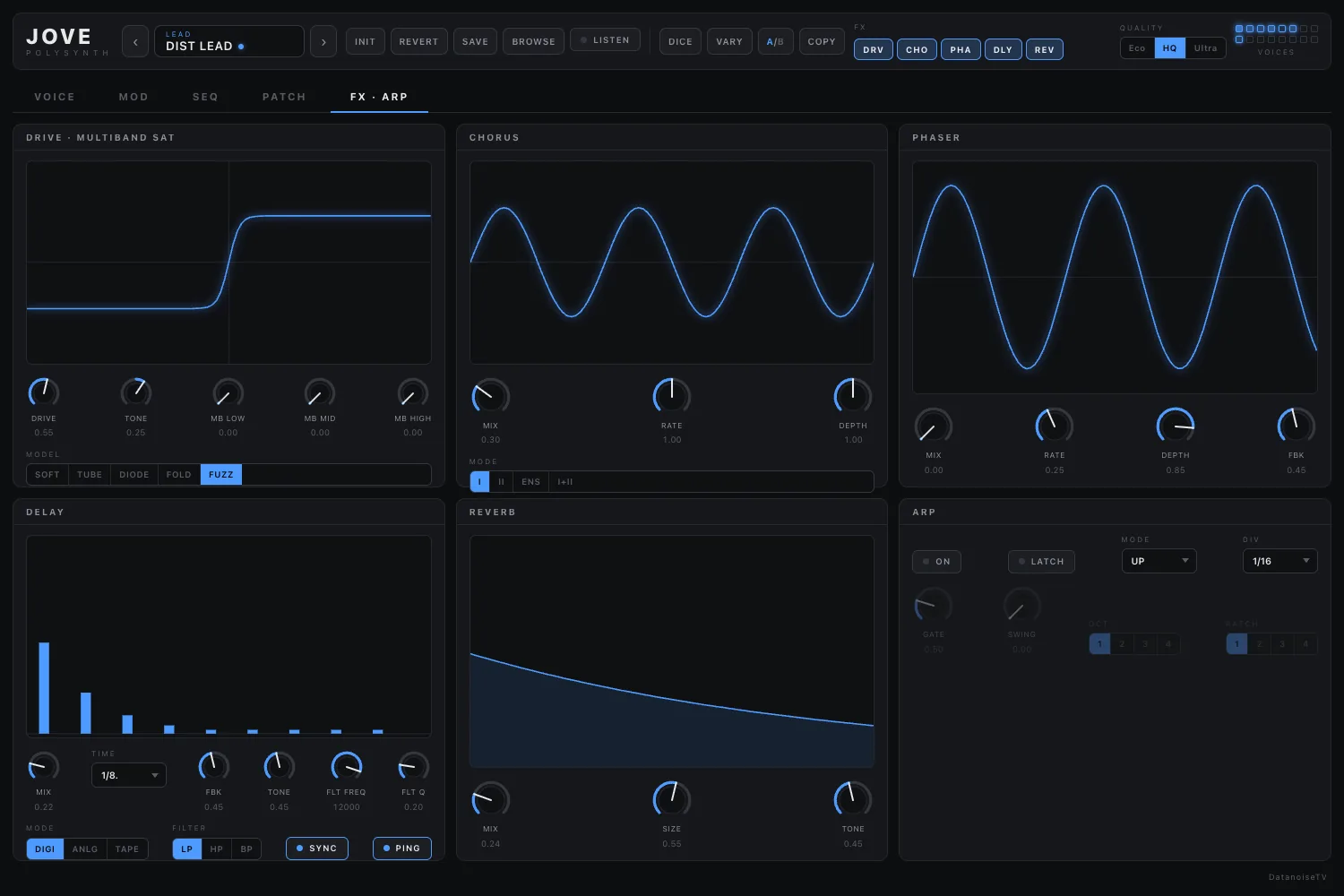
There is an arpeggiator with twelve modes, ratcheting, swing, latch and host-transport lock. And three quality settings (Eco, HQ and Ultra) that oversample the whole voice path at one, two or four times, so you can write with a light CPU load and render with a heavy one.
Everything it does
- A patchbay, not a routing menu
- Eleven sources across eleven destinations with bipolar gains, rewiring the actual audio path. FM any oscillator from any node, chain the filters, or close a feedback loop that is delayed one sample so it cannot blow up.
- Five oscillators that can each be different
- Continuous morph from sine to pulse, or a 64-table wavetable scan, with per-oscillator footage, detune, bit-crush and sample-rate reduction, so one voice can be filthy inside a clean patch.
- Seven filters, level-matched
- A ladder, a state-variable in four modes, a low-pass gate and a Steiner-Parker, matched at the cutoff so switching model changes the character and not the loudness.
- Modulation drawn on the controls
- A 32-slot matrix edited as a grid, with every modulated knob showing its range as an arc and a live dot moving inside it. You watch the envelope pull the cutoff instead of imagining it.
- A bank you can browse by ear
- 140 patches loudness-matched across the whole set to within a decibel, with an audition mode that plays a category-appropriate phrase at your host tempo.
- Somewhere to start when you are stuck
- DICE builds a new patch from a musical archetype instead of randomising into noise; VARY perturbs the one you have. A/B compare and revert-to-preset throughout.
- Written light, rendered heavy
- Eco, HQ and Ultra oversample the entire voice path at 1×, 2× or 4×, so arrangement and bounce can have different CPU budgets.
Specifications
| Type | Virtual analogue synthesizer |
|---|---|
| Oscillators | 5 morphing or wavetable, plus sub, noise and ring modulation |
| Wavetables | 64-table bank, scannable |
| Filters | 2 filters, 7 models, single, serial or parallel, cutoff-matched |
| Modulation | 3 envelopes, 3 LFOs, 4 step sequencers into a 32-slot matrix |
| Patchbay | 11 sources × 11 destinations, bipolar, one-sample-delayed feedback |
| Polyphony | Up to 16 voices; unison to 7 per note with detune and spread |
| Expression | Full MPE: per-note bend, pressure and timbre |
| Arpeggiator | 12 modes with ratcheting, swing, latch and transport lock |
| Effects | Drive (5 models), multiband saturation, chorus, phaser, delay, reverb |
| Quality | Eco, HQ and Ultra. 1×, 2× or 4× oversampling of the voice path |
| Presets | 140 in 12 categories, loudness-matched to ±1 dB |
| Formats | VST3 · AU · Standalone |
| Systems | macOS · Windows · Linux |
| Current release | v1.1.1, 2026-07-19 |
Screens
Captured from the running plugin.
Download
Current release v1.1.1, 2026-07-19. macOS builds are not notarised yet — right-click the plugin and choose Open the first time.