Klangschale
Resonant metal, struck, rubbed and bowed
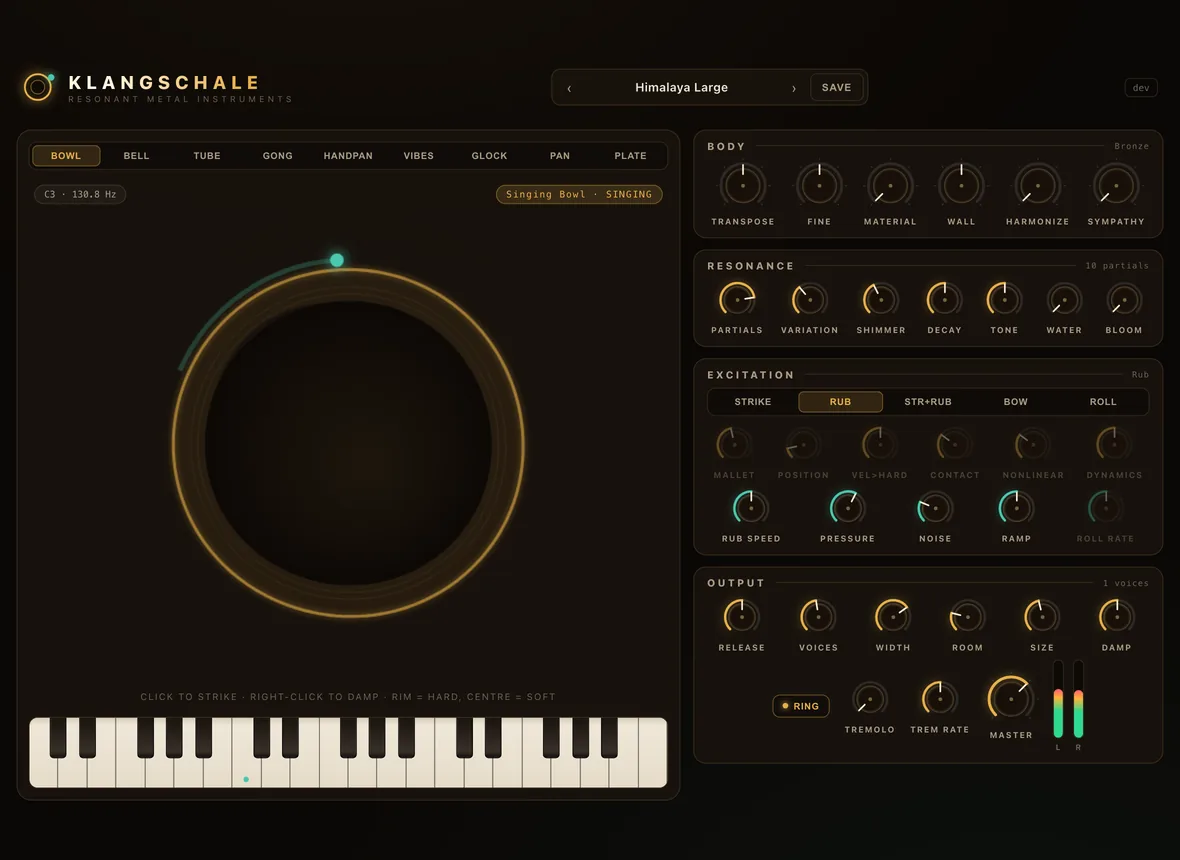
The friction model is the reason this exists. Rub a bowl and the slow build-up, the pulsing and the way it refuses to get any louder are not scripted. They fall out of the stick and slip between the puja and the surface.
- Type
- Modal synthesis
- Formats
- VST3 · AU · CLAP · Standalone
- Systems
- macOS · Windows · Linux
- Version
- Source
- Licence
- GPL-3.0
Measured figures
- 9
- Metal bodies, each on a modal series taken from the acoustics literature.
- 5
- Ways to excite one: strike, rub, both at once, bow, or roll.
- 24
- Complex resonators per voice at the top of the range.
- 3.0%
- Of one core for a full sixteen-voice render with everything on.
- 32
- DSP checks that measure the acoustic claims instead of asserting them.
Friction that sings
Anyone can make a bowl ring by hitting it. Making one sing by rubbing the rim is harder, and it is the thing sample libraries cannot do, because a sung bowl is a feedback loop between your hand and the metal. Push harder and it does not simply get louder.
What is in here is true stick-slip: a velocity-weakening friction curve between the exciter and the modal surface velocity, at a rotating contact point for the puja or a fixed one for a bow. The slow build-up, the pulsing as the contact point goes round, and the self-limiting loudness all emerge from that. The chatter is gated by the slip state, so grit pours out while the puja slips and dies while it sticks.
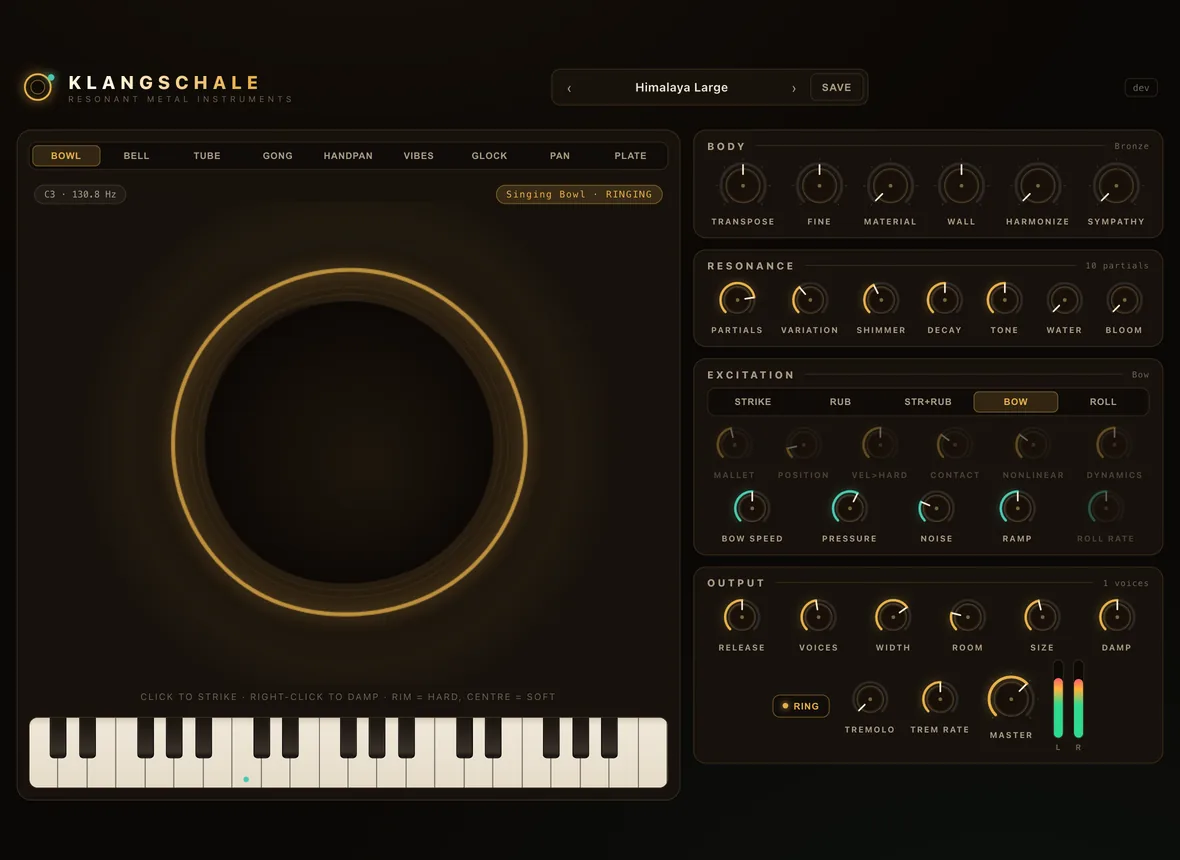
Five ways to excite a body: strike it, rub it, do both together, bow it at a fixed point, or roll on it with humanised re-strikes that swell into a crescendo under pressure.
Nine bodies, each from its own literature
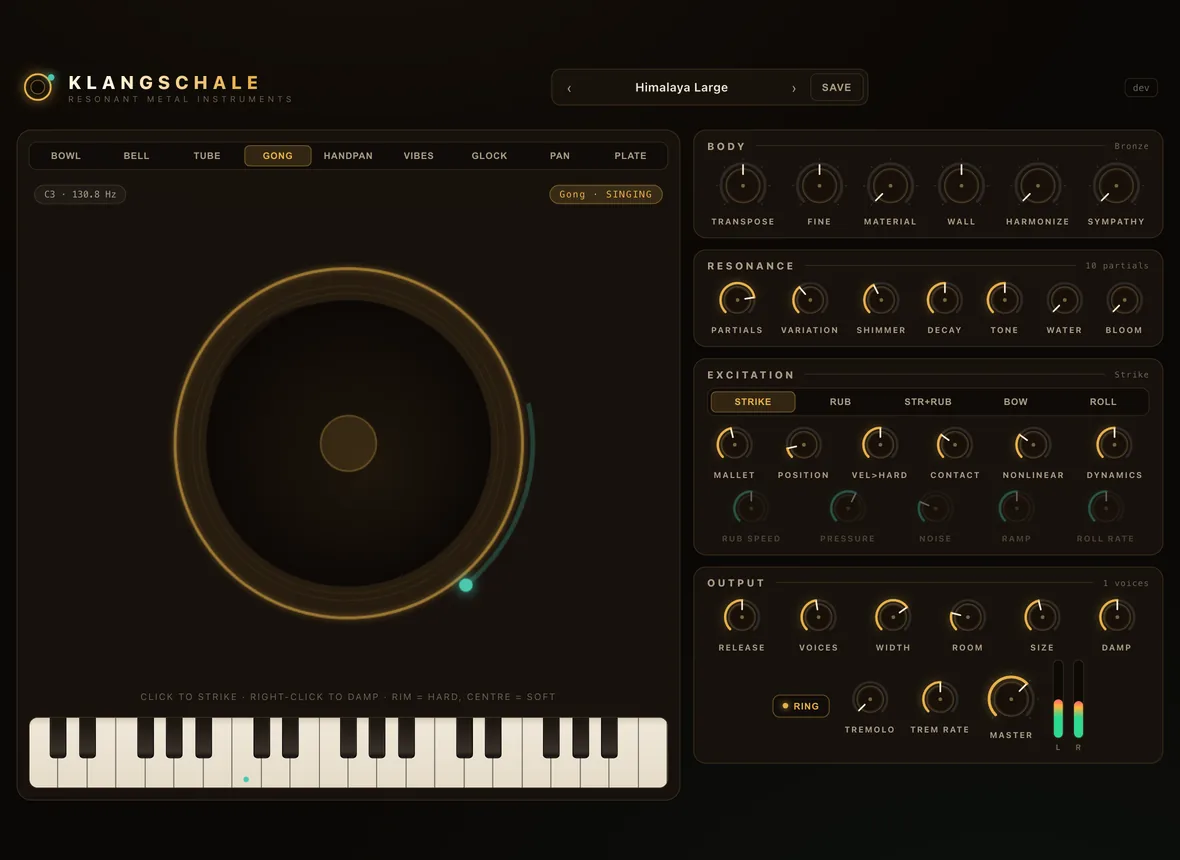
The singing bowl comes from Rayleigh’s inextensional shell law, which puts its partials at 1 : 2.83 : 5.42 : 8.77. The church bell has the hum, prime, tierce, quint and nominal that give it its minor-third character. The tubular bell has free-free tube modes whose upper three sit at 2 : 3 : 4 and imply a strike pitch that is not in the spectrum at all.
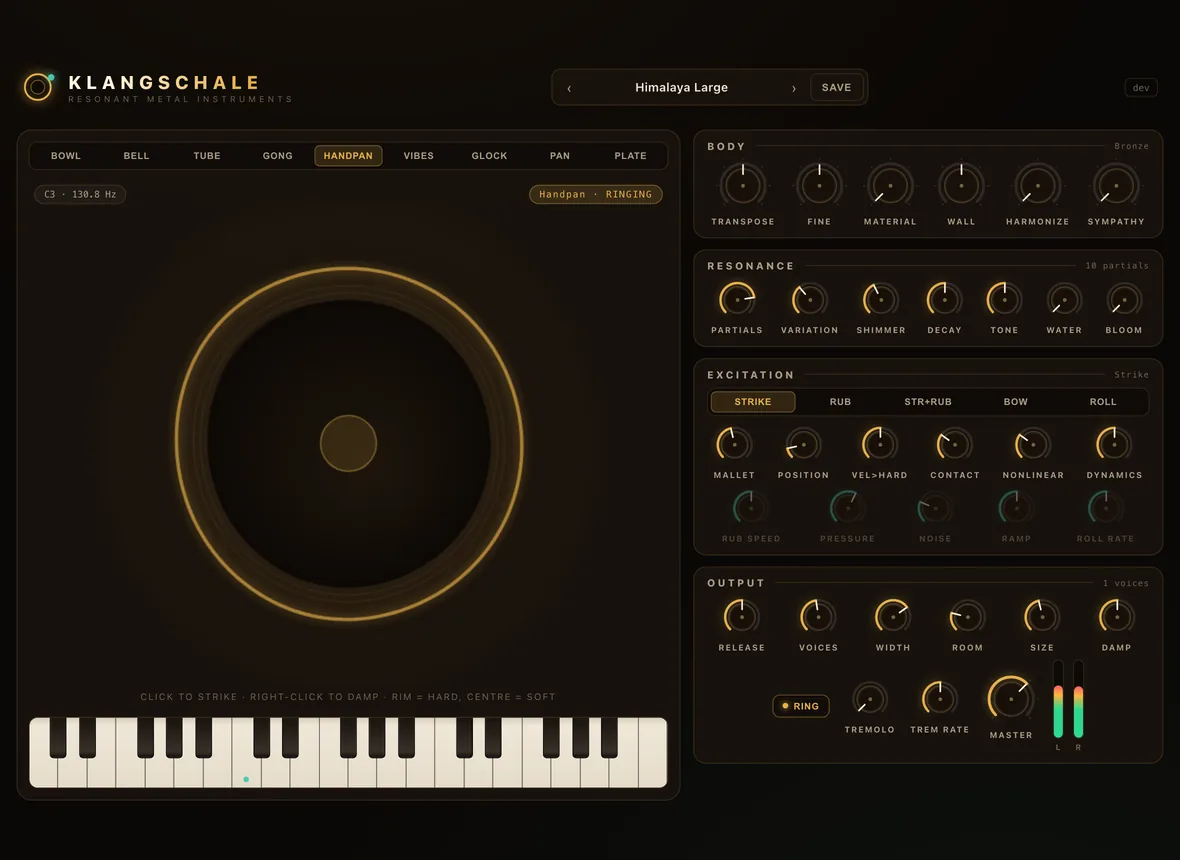
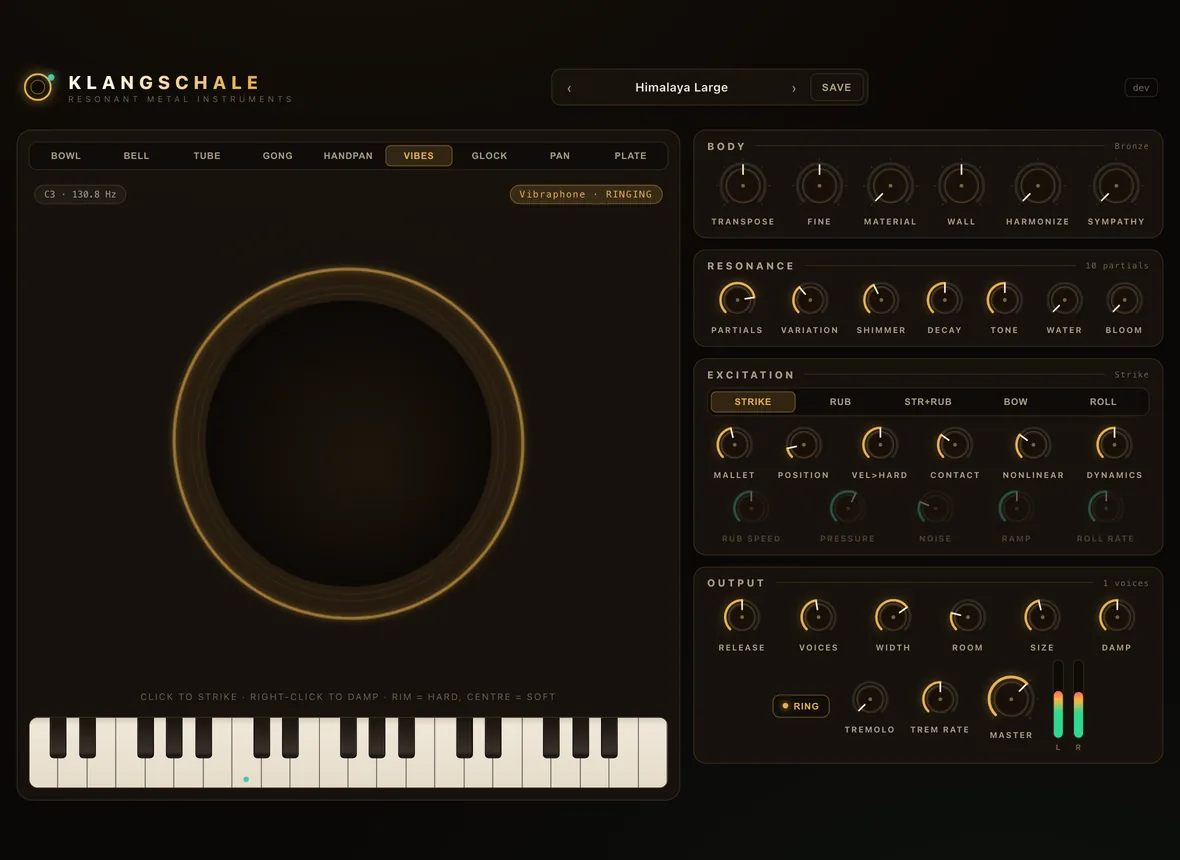
Then the gong and tam-tam as dense inharmonic clusters, the handpan at 1 : 2 : 3, the vibraphone as a deep-arch bar at 1 : 4 : 10, the glockenspiel’s untuned bar series, and the steelpan with its strong octave. Every one is normalised to the perceived pitch, so it plays the note you press.
Each mode is a pair split by a few hertz, which is where the beating shimmer of hammered metal comes from. Gongs and tam-tams withhold their high modes at the strike and swell them in over the following seconds, harder hits blooming deeper.
Made to be played, not triggered
Sixteen voices with per-channel bend and pressure, so MPE expression works without configuring anything. Mod wheel and aftertouch lean into the surface while a bowl is singing. Striking one body feeds every other body sounding on the same mount, so chords bloom into each other the way a real bell stand does.
Every note is its own deterministic body. Variation scatters the ratios, gains and decay per note, so the same note is the same bowl on every take, and Harmonize morphs the authentic ratios toward integers when you need bells that will sit in tonal writing.
Tails run for tens of seconds by design. There is a Decay control and a Ring switch for when that is not what the track wants.
Everything it does
- A bowl that actually sings
- True stick-slip friction at a rotating contact point. The build-up, the pulsing at the rotation rate and the self-limiting loudness come out of the model instead of being drawn as envelopes.
- Nine bodies from measured series
- Each modal series taken from the acoustics literature and normalised to the perceived pitch, so a bell plays the note you press even though its own spectrum does not contain it.
- Beating built in
- Every mode is a pair split by a few hertz, which is the shimmer of hammered metal, and the pair members pan apart so it swirls across the image.
- Bodies that hear each other
- Striking one body feeds every other body sounding on the same mount, so chords bloom into one another.
- The same bowl every take
- Per-note variation is deterministic. The note you liked yesterday is the note you get today.
- Measured, not asserted
- Thirty-two DSP checks verify the modal ratios to half a percent, plus decay ordering, beat depth, bloom swell, roll periodicity and the friction build-up.
Specifications
| Type | Modal synthesis |
|---|---|
| Instruments | Bowl, bell, tubular bell, gong, handpan, vibraphone, glockenspiel, steelpan, tam-tam |
| Excitation | Strike, rub, strike and rub, bow, roll |
| Friction | Velocity-weakening stick-slip at a rotating or fixed contact point |
| Resonators | Up to 24 complex resonators per voice, as split mode pairs |
| Polyphony | 16 voices, sample-accurate MIDI |
| Expression | Per-channel bend and pressure, sustain pedal, CC66 damp |
| Tuning | Variation per note, Wall stretches the series, Harmonize pulls it toward integers |
| Space | 8-line Householder feedback delay network |
| Presets | 23 factory |
| CPU | 3.0% of one Apple-silicon core for 16 voices with room, bloom and tremolo |
| Formats | VST3 · AU · CLAP · Standalone |
| Systems | macOS · Windows · Linux |
Screens
Captured from the running plugin.
Download
macOS builds are not notarised yet — right-click the plugin and choose Open the first time.